Within Kecksburg
How Reliable Are Kecksburg Witness Memories?
Kecksburg shows how sincere witness accounts can preserve clues while also changing through retelling.
On this page
- Early versus later accounts
- Memory and media effects
- Corroboration tests
Page outline Jump by section
Introduction
Kecksburg is a useful test case for eyewitness memory because the witnesses do not need to be dismissed as foolish or dishonest for the story to have changed. The safest conclusion is more careful: many people sincerely saw a spectacular fireball on 9 December 1965, some local residents later remembered smoke, lights, searches, roadblocks or military activity near Kecksburg, and still later versions added sharper details such as a metallic acorn-shaped object, strange markings, a convoy and a secret recovery. The key question is not whether every witness lied, but how early impressions, local talk, news coverage, UFO investigators, television reconstructions and decades of retelling may have interacted with real memories. That matters because Kecksburg’s enduring mystery rests less on a single document than on changing human testimony — valuable evidence, but evidence that must be tested against timing, independence and corroboration.
Early Versus Later Accounts
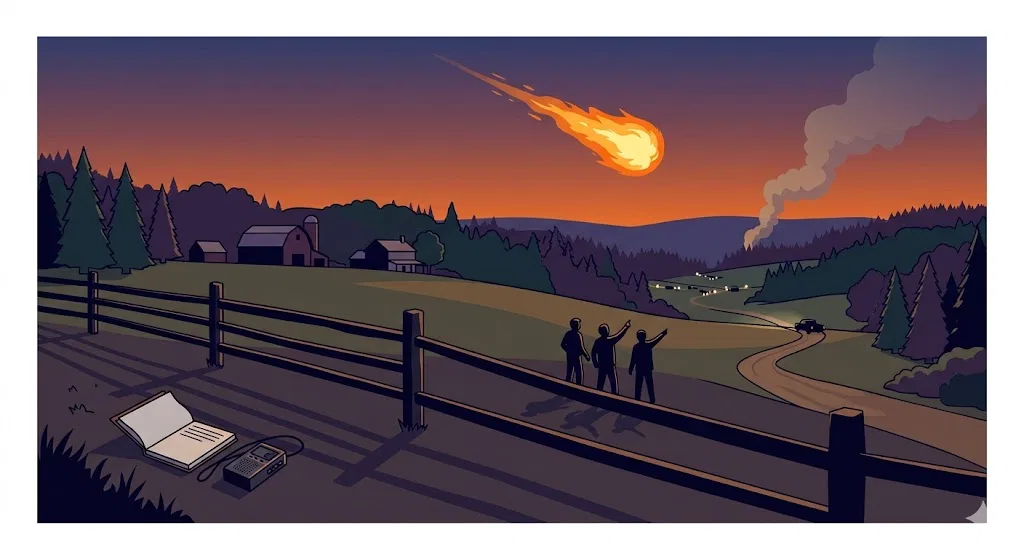
The strongest eyewitness material in the Kecksburg case is the wide-area observation of a bright aerial event. A later review of the Great Lakes fireball notes that the 9 December 1965 bolide was seen from ten US states and Ontario, was brighter than the full Moon, lasted only a few seconds, changed colour, brightened or burst, and left a persistent train visible for some time. That broad pattern is consistent with a dramatic meteor-like event that many people could misjudge as nearby, especially if they saw it disappear behind trees, hills or buildings. Robert R. Young’s review of the case also notes that witnesses in 1965 reported the fireball as having “crashed” or “landed” in at least 17 places across six states, a clue that perceived impact location was not a reliable guide to actual impact location.[Academia]academia.eduPDF) The Reliability of UFO Witness TestimonyAcademia(PDF) The Reliability of UFO Witness Testimony…
The local Kecksburg story begins in that confusion. In one reconstruction, eight-year-old Nevin Kalp reportedly described seeing “a star on fire”, while his mother later saw smoke over nearby woods and contacted local radio and police after hearing UFO talk on KDKA radio. Young argues that the line of sight from the Kalp location pointed towards the Lake Erie fireball and that later attention shifted towards a search location, then towards a different published location that remained influential for decades.[Academia]academia.eduPDF) The Reliability of UFO Witness TestimonyAcademia(PDF) The Reliability of UFO Witness Testimony…
That distinction is important: the earliest layer is about a fireball, smoke, a possible crash, and a search. The later popular layer is more specific and more cinematic: an acorn-shaped craft, hieroglyphic-like markings, armed military control and removal on a lorry. The more detailed a claim becomes after years of discussion, the more it needs independent support from records made close to the event. In Kecksburg, many of the best-known concrete object descriptions became prominent long after 1965, not in the first public record.
This does not mean later witnesses should be ignored. Some people may have held back, feared ridicule, or only spoke publicly when the subject became culturally safer. But late testimony must be separated into different grades. A person who says decades later, “I remember a search, lights and excitement,” is making a weaker and more plausible memory claim than someone who adds precise dimensions, markings, military unit details, or a secret chain of custody. The first kind may preserve genuine local experience; the second kind needs external verification.

Why Retelling Can Change a Sincere Memory
Eyewitness memory is not a video recording. The US National Research Council’s 2014 report on eyewitness identification emphasised that human perception, memory and confidence are malleable, and that mistaken identifications can have serious consequences even when witnesses are sincere. Although that report focuses on criminal identification rather than UFO cases, the principle applies directly to Kecksburg: confidence and vividness are not the same as independent accuracy.[National Academies]nationalacademies.orgOpen source on nationalacademies.org.
A key mechanism is post-event information. After an unusual event, people talk to neighbours, listen to radio, read newspapers, watch television, meet investigators and later encounter documentaries. Each contact can add details that become difficult to separate from the original perception. A chapter on cognition and memory distortion in The Reliability of UFO Witness Testimony describes how time, forgetting, stress, suggestion, conversations with other witnesses and media information can alter later testimony; it also notes that witnesses may report later interpretations as if they were originally observed, without consciously intending to deceive.[Academia]academia.eduPDF) The Reliability of UFO Witness TestimonyAcademia(PDF) The Reliability of UFO Witness Testimony…
Kecksburg had nearly every condition that makes this process powerful. The event was brief and startling. It occurred at dusk. It was followed by rumours of a crash. Local people searched or gathered near the woods. Officials and police were present. Newspapers and radio reported conflicting information. UFO researchers later revisited the story. Television programmes gave the case a vivid visual template. In that environment, the line between “what I saw”, “what I heard that night”, “what people later said”, and “what the reconstruction showed” can become blurred.
The point is not that all contamination runs in one direction. A sceptical official explanation can also shape memory, making some people understate what they saw or reinterpret something unusual as ordinary. But in the Kecksburg case, the most visible long-term pressure favoured a richer crash-recovery narrative: the acorn replica, the “Pennsylvania’s Roswell” label, military secrecy motifs, and comparisons with other UFO crash stories all gave witnesses and audiences a shared language for retelling the event.
The Media Did Not Just Report the Story
Kecksburg’s witness tradition changed partly because media coverage became part of the evidence environment. Young’s review argues that early confusion was amplified by a 1965 article from UFO writer Ivan Sanderson, who relied on published reports rather than direct witness interviews and, according to Young, made trajectory and speed errors that helped launch the idea of a slow, manoeuvring object.[Academia]academia.eduPDF) The Reliability of UFO Witness TestimonyAcademia(PDF) The Reliability of UFO Witness Testimony…
The biggest turning point came much later. The 1990 Unsolved Mysteries treatment presented the case with dramatic force and created a physical acorn-shaped model based on witness accounts. Young states that the episode reached tens of millions of viewers, was repeated many times, and was followed over the next 24 years by several more nationally televised programmes about Kecksburg. He also reports that more than 100 “new” witnesses called the programme’s hotline after the broadcast.[Academia]academia.eduPDF) The Reliability of UFO Witness TestimonyAcademia(PDF) The Reliability of UFO Witness Testimony…
That does not automatically invalidate the post-1990 witnesses. It does, however, change how their testimony must be handled. A memory reported after a widely watched reconstruction is no longer independent of the public image of the case unless there is evidence that the same detail was recorded earlier. If a witness described a large covered object before the broadcast, that is one evidentiary category. If the same detail appears for the first time after the broadcast, it is another.
The Unsolved Mysteries archive illustrates the later narrative in its strongest popular form. It presents Bill Weaver as saying there was something glowing in the ravine and that “they took something out”, and John Hays as recalling a flat-bed truck carrying an object about the size of a Volkswagen Beetle. It also presents James Romansky questioning why officials did not display the object if it was merely a meteorite. These are memorable claims, but they are preserved in a television mystery format rather than in a contemporaneous 1965 statement.[Unsolved Mysteries]unsolved.comMysteries Kecksburg UFOMysteries Kecksburg UFO
The John Murphy Problem
No discussion of changing testimony at Kecksburg can avoid John Murphy, the WHJB radio news director whose name became central to the case. In some later accounts, Murphy was among the first reporters near the scene, took photographs, prepared a radio documentary called Object in the Woods, and then had material removed or softened after alleged official pressure. Atlas Obscura summarises the legend as involving claims that officials confiscated photos, that the aired documentary was heavily edited, and that Murphy’s later death in a hit-and-run accident fed suspicion.[Atlas Obscura]atlasobscura.comAtlas Obscura Space Acorn in KecksburgAtlas Obscura Space Acorn in Kecksburg
This is a powerful story because it provides a human bridge between early journalism and later cover-up claims. But it also shows the difficulty of relying on testimony about testimony. Much of the Murphy narrative depends on recollections by people who heard, saw, or later remembered what the unaired or original version supposedly contained. Unless the original photos, tapes, scripts or station records can be authenticated, the story remains suggestive rather than decisive.
Young’s reconstruction takes a different view of Murphy’s role. It says that Murphy initially reported smoke and sparks at what he thought was a crash site, but that this was about 1.5 miles west of Kecksburg where brush and trees were being burned at the Norvelt Golf Course construction site. Young also says Murphy’s later radio special reported no large military presence except three Air Force men in the back seat of a police car, and that the station stated no government agency had intervened in the broadcast.[Academia]academia.eduPDF) The Reliability of UFO Witness TestimonyAcademia(PDF) The Reliability of UFO Witness Testimony…
The result is a classic Kecksburg pattern: the same person can be used to support opposite readings. In the crash-recovery version, Murphy is a silenced reporter. In the sceptical version, he is a reporter caught in the confusion of a fast-moving local story. The responsible reading is to treat Murphy as important but unresolved: a potentially valuable contemporary witness whose strongest claimed evidence is unavailable.
What Corroboration Tests Should Be Applied?
Kecksburg testimony should be tested by asking not just “does this person seem credible?” but “what kind of memory is this, when was it recorded, and what independent evidence supports it?” A sincere witness can still be wrong about distance, timing, sequence, identity of officials, or whether a later idea came from original perception.
The most useful tests are straightforward:
- Timing: Was the statement recorded on 9 or 10 December 1965, soon after the event, or years later after UFO books, radio discussions and television programmes had circulated?
- Independence: Did the witness give the detail before hearing the same detail from neighbours, investigators, newspapers or television?
- Specificity: Is the claim a broad memory of a fireball, search or roadblock, or a detailed claim about object shape, markings, military units or removal?
- Convergence: Do multiple witnesses independently report the same detail without sharing a source, or do the details cluster after a major media event?
- Documentary fit: Does the testimony align with police, Air Force, press or scientific records from the time, or does it require those records to be wrong, missing or deliberately misleading?
- Alternative explanations: Could lights, smoke, road closures, search teams, camera strobes, brush fires or ordinary military UFO-report procedures explain part of the memory?
Young’s sceptical reconstruction argues that three newspapers, a Pittsburgh television station and Murphy were present during the searches and did not report armed troops, convoys or objects in the woods; it also says State Police and news media searched again in daylight and found nothing. That is not final proof nothing happened, but it is a major check against the most elaborate recovery claims.[Academia]academia.eduPDF) The Reliability of UFO Witness TestimonyAcademia(PDF) The Reliability of UFO Witness Testimony…
On the other side, later researchers and journalists have pointed to the persistence of local testimony and the fact that the case generated official-record disputes. NASA was ordered in 2007 to conduct a more thorough search of its files after a Freedom of Information Act lawsuit by journalist Leslie Kean, supported by the Sci Fi Channel. The Reporters Committee for Freedom of the Press described the lawsuit as seeking documents about an alleged object that fell near Kecksburg in 1965.[Reporters Committee]rcfp.orgOpen source on rcfp.org.
That record dispute matters, but it should not be made to carry more than it proves. A missing or incomplete file can justify further inquiry; it does not by itself verify a witness’s memory of an acorn-shaped craft. Equally, an official statement that a search found nothing does not erase every witness’s experience of confusion, roadblocks, lights or military presence. Corroboration is about narrowing the claim, not forcing every detail into one all-or-nothing verdict.
What the Changing Testimony Reveals
The most useful lesson from Kecksburg is that eyewitness memory can preserve real clues while also absorbing later story elements. The wide-area fireball reports are robust because they are numerous, geographically broad and supported by astronomical analysis. The local search and excitement are also plausible because they fit the immediate situation: reports of a possible crash, police response, fire crews, and Air Force interest in unidentified aerial reports. The hardest claims are the most specific late-stage ones: a clearly seen acorn-shaped object, strange writing, a concealed military recovery, and later tales of bodies or secret-base transfers.
This layered view avoids two common mistakes. The first is the believer’s mistake: treating all witness accounts as cumulative, as if every later detail simply adds more evidence. In reality, later testimony may be dependent on earlier rumours, media images or investigator expectations. The second is the debunker’s mistake: treating inconsistency as proof that everyone was lying or that nothing socially interesting happened. Kecksburg’s story endured precisely because a real dramatic sky event met a community experience that many people felt official explanations did not fully respect.
The best reading is therefore cautious but not dismissive. Kecksburg witnesses are central to the case, but their memories must be read historically. Early accounts deserve the most weight; later accounts can be useful when they are stable, specific and independently corroborated; dramatic details that appear after media reconstruction deserve the most scrutiny. The changing testimony does not solve Kecksburg, but it explains why the case remains so hard to settle: the evidence is not only in the sky or the woods, but in decades of human remembering.
Amazon book picks
Further Reading
Books and field guides related to How Reliable Are Kecksburg Witness Memories?. Use these as the next step if you want deeper reading beyond the article.
Eyewitness Testimony
Directly addresses how memories change, how questioning affects recall, and how eyewitness accounts should be evaluated.
The Believing Brain
Explains why people form and reinforce beliefs, including paranormal and conspiracy-related interpretations.
Mistakes Were Made (but Not by Me)
Explains self-justification, memory revision, and how people sincerely maintain inaccurate beliefs.
Why People Believe Weird Things
Rating: 4.0/5 from 7 Google Books ratings
Provides tools for assessing extraordinary claims and evolving narratives.
eBay marketplace picks
Marketplace Samples
Live-tested eBay searches with available results related to this page.


Endnotes
1.
Source: academia.edu
Title: (PDF) The Reliability of UFO Witness Testimony
Link:https://www.academia.edu/101922617/The_Reliability_of_UFO_Witness_Testimony
Source snippet
Academia(PDF) The Reliability of UFO Witness Testimony...
2.
Source: unsolved.com
Title: Mysteries Kecksburg UFO
Link:https://unsolved.com/gallery/kecksburg-ufo/
3.
Source: academia.edu
Link:https://www.academia.edu/105809707/Reliability_of_UFO_Witness_Testimony_in_Extreme_Close_Encounters_Abductees_and_Contactees_
4.
Source: nationalacademies.org
Link:https://www.nationalacademies.org/read/18891/chapter/2
5.
Source: atlasobscura.com
Title: Atlas Obscura Space Acorn in Kecksburg
Link:https://www.atlasobscura.com/places/space-acorn
6.
Source: rcfp.org
Link:https://www.rcfp.org/judge-forces-nasa-take-giant-leap-foia-suit/
7.
Source: youtube.com
Link:https://www.youtube.com/watch?v=vROJdm_xGAQ
8.
Source: nationalacademies.org
Link:https://www.nationalacademies.org/read/18891
9.
Source: rcfp.org
Title: nasa ordered review its records data ufo sighting
Link:https://www.rcfp.org/nasa-ordered-review-its-records-data-ufo-sighting/
10.
Source: space.com
Title: 7589 case finally closed 1965 pennsylvania ufo mystery
Link:https://www.space.com/7589-case-finally-closed-1965-pennsylvania-ufo-mystery.html
11.
Source: post-gazette.com
Link:https://www.post-gazette.com/news/science/2015/12/06/50-years-later-the-kecksburg-westmoreland-county-ufo-is-identified-probably/stories/201512060146
Additional References
12.
Source: youtube.com
Title: The New Science of Eyewitness Memory | John Wixted | TED
Link:https://www.youtube.com/watch?v=93ocNhHyGVo
Source snippet
Elizabeth Loftus on Eyewitness Testimony...
13.
Source: skepticalinquirer.org
Link:https://skepticalinquirer.org/1991/04/old-solved-mysteries-the-kecksburg-incident/
14.
Source: researchgate.net
Link:https://www.researchgate.net/publication/387301035_The_reliability_of_UFO_witness_testimony_By_V-J_Ballester_Olmos_Richard_W_Heiden_Eds_Turin_Upiar_Press_2023_pp_711
15.
Source: nobaproject.com
Link:https://nobaproject.com/modules/eyewitness-testimony-and-memory-biases
16.
Source: facebook.com
Link:https://www.facebook.com/MichellewRIGHTNOW/posts/here-is-the-story-i-did-on-the-60th-anniversary-of-the-kecksburg-ufo-we-still-ha/1399476958213112/
17.
Source: enigmalabs.io
Link:https://enigmalabs.io/library/f45bb19d-5803-4ab6-a373-8799f64095c0
18.
Source: facebook.com
Link:https://www.facebook.com/groups/pennsylvaniaphotos/posts/3965626140374425/
19.
Source: imdb.com
Link:https://www.imdb.com/title/tt0985950/
20.
Source: reddit.com
Link:https://www.reddit.com/r/aliens/comments/mlf13o/kecksburg_ufo_incident_solved_it_was_potentially/
21.
Source: researchgate.net
Link:https://www.researchgate.net/profile/Robert-Belli/publication/254899688_Misinformation_Effects_and_the_Suggestibility_of_Eyewitness_Memory/links/556f158d08aeab7772282b35/Misinformation-Effects-and-the-Suggestibility-of-Eyewitness-Memory.pdf
Topic Tree