Within Great Lakes
Meteor or Space Debris in the Sky?
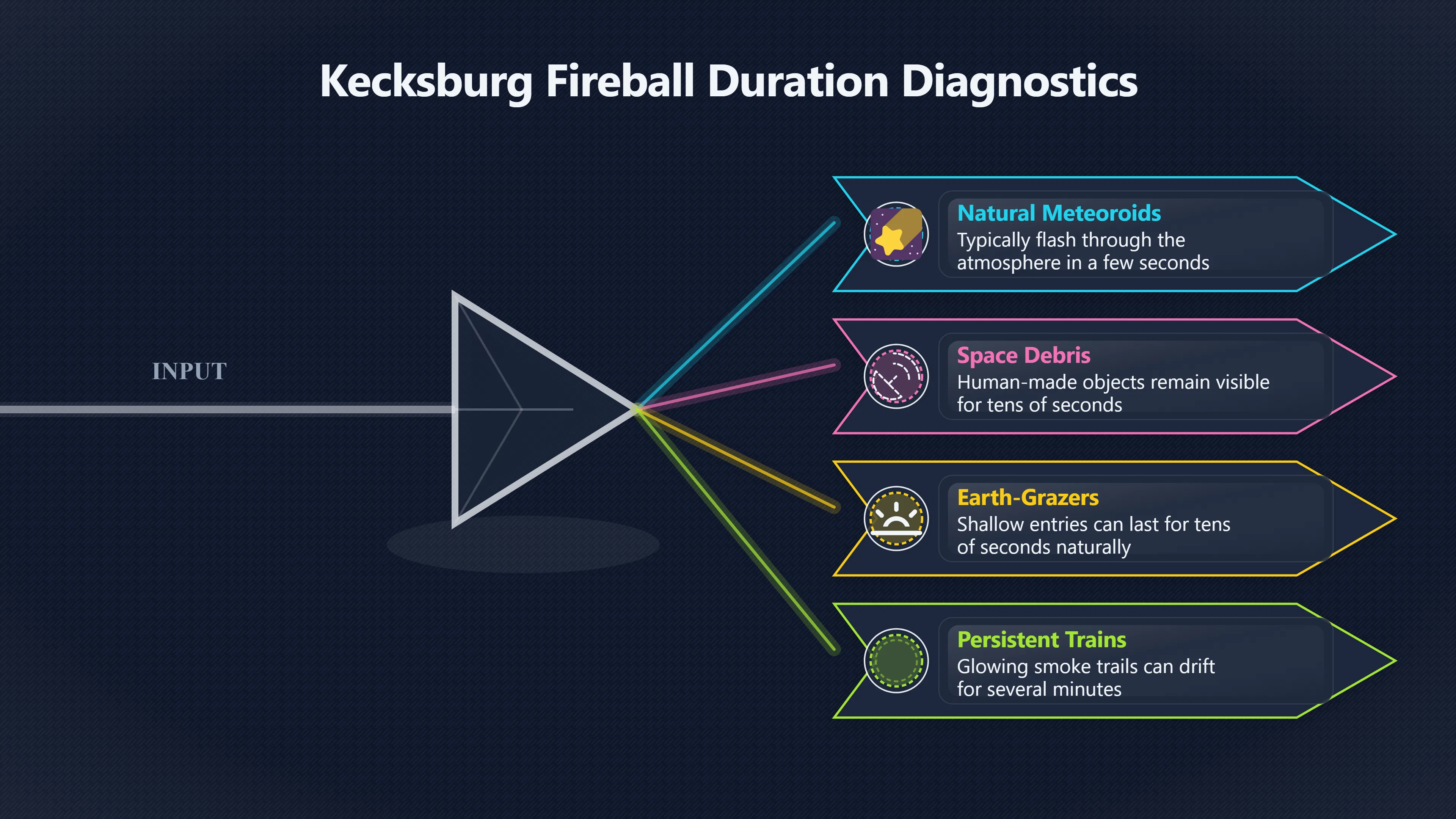
Duration estimates are a key test because ordinary fireballs and artificial re-entries behave differently in the sky.
On this page
- How long fireballs usually last
- Why lingering trains confuse witnesses
- How duration affects the Kecksburg explanation
Page outline Jump by section
Introduction
One of the most useful clues in the Detroit–Windsor reconstruction of the Kecksburg event is not where the object appeared, but how long different parts of it remained visible. Investigators attempting to explain the 9 December 1965 fireball have repeatedly returned to a simple question: did witnesses observe a brief meteor-like fireball, or a slower object such as re-entering space debris?
 Duration matters because meteors and artificial re-entries usually behave differently in the atmosphere. A bright meteor fireball is normally visible for only a few seconds, whereas space debris often remains visible for tens of seconds or longer as it descends and fragments. The Kecksburg case is complicated because many witnesses remembered both a short-lived luminous object and a much longer-lasting trail. Separating those two phenomena is essential to understanding what the Detroit–Windsor evidence actually indicates.[Popular Astronomy]popastro.comPopular Astronomy Detailed Fireball Reporting GuidePopular AstronomyDetailed Fireball Reporting Guide - Meteor SectionJanuary 18, 2018 — Very few fireballs last more than 5 or 10 seconds…
How Long Fireballs Usually Last
Astronomical reporting guides consistently treat duration as a major diagnostic feature. The British Astronomical Association’s fireball reporting guidance notes that very few natural fireballs remain visible for more than five to ten seconds, while man-made re-entry events can stay visible for several tens of seconds and sometimes up to a couple of minutes.[Popular Astronomy]popastro.comPopular Astronomy Detailed Fireball Reporting GuidePopular AstronomyDetailed Fireball Reporting Guide - Meteor SectionJanuary 18, 2018 — Very few fireballs last more than 5 or 10 seconds…
The American Meteor Society uses a similar rule of thumb when screening reports. It advises that most genuine fireballs are visible only for a few seconds and warns against reporting events lasting more than about thirty seconds as ordinary meteors.[fireball.amsmeteors.org]fireball.amsmeteors.org; Please, don't report recurringReport a Fireball - American Meteor SocietyPlease, don't report sighting that lasted more than 30 seconds:the vast majority of fireballs…
Space-debris specialists likewise emphasise the contrast. The Aerospace Corporation’s re-entry guidance explains that natural meteors typically flash through the atmosphere in a matter of seconds, while human-made objects generally move more slowly and may remain visible for roughly 20 to 90 seconds or even longer. Because orbital debris enters the atmosphere at lower speeds than many meteoroids and often breaks apart progressively, observers can watch the process unfold over a much longer period.[aerospace.org]aerospace.orgWhat Does a Reentry Look LikeThe general rule-of-thumb is that natural meteor reentries happen quickly and typically last less than a few…
Applied to the Kecksburg event, this distinction is significant because many contemporary descriptions of the luminous object itself describe a brilliant, fast-moving fireball crossing a large region rather than a slow object lingering in view. That pattern aligns more naturally with a bolide, a particularly bright meteor fireball.[Wikipedia]WikipediaKecksburg UFO incidentKecksburg UFO incident
Why Lingering Trains Confuse Witnesses
The duration test becomes less straightforward when a fireball leaves a persistent train.
A persistent train is the glowing or smoke-like trail left behind after a bright meteor has already passed. Meteor researchers have long documented these trains, which can remain visible long after the meteor itself has vanished. The original object may last only seconds, yet the trail can continue to evolve and drift for minutes under the influence of upper-atmospheric winds.[International Meteor Organization]imo.netInternational Meteor OrganizationPART 4: METEOR TRAINSJanuary 10, 2002 — Bright meteors, particularly fireballs, often leave an “afterglo…
This distinction is particularly important for the Detroit–Windsor reconstruction. Contemporary analyses relied partly on photographs of the trail taken after the fireball had passed. Those photographs helped reconstruct the trajectory, but they did not show the meteor itself still flying through the atmosphere. Instead, they recorded the lingering train left behind by the event.[Wikipedia]WikipediaKecksburg UFO incidentKecksburg UFO incident
For eyewitnesses, however, the difference is not always obvious. A bright trail that remains visible against the evening sky can create the impression that the object itself is still present. As the train twists, spreads, changes shape, or drifts with high-altitude winds, observers may perceive continued motion and infer that a craft is slowing, manoeuvring, or descending. The longer the train remains visible, the easier it becomes for memories of the brief fireball and the persistent trail to merge into a single narrative.
This is one reason duration estimates in major fireball events often vary widely. People may accurately remember watching something for several minutes, yet the actual luminous meteor may have existed for only a few seconds. The remainder of the observation involved the train rather than the fireball.[International Meteor Organization]imo.netInternational Meteor OrganizationPART 4: METEOR TRAINSJanuary 10, 2002 — Bright meteors, particularly fireballs, often leave an “afterglo…
Why Duration Alone Is Not a Perfect Test
Although duration is a powerful clue, it is not an absolute rule.
Researchers studying atmospheric entries note that exceptional meteors can occasionally remain visible much longer than the typical few-second event. Shallow-entry meteors, sometimes called Earth-grazers, may traverse a long atmospheric path and remain visible for tens of seconds. The well-known Peekskill meteor of 1992 is frequently cited as an example of a natural object whose behaviour could resemble that of a re-entering spacecraft.[aerospace.org]aerospace.orgf meteors lasting tens of seconds in duration.Read more…
Conversely, not every long-lasting sighting is necessarily space debris. Duration must be considered alongside speed, fragmentation pattern, trajectory, altitude, and other evidence. Experts therefore treat duration as one diagnostic feature rather than a decisive identifier.[aerospace.org]aerospace.orgf meteors lasting tens of seconds in duration.Read more…
For the Kecksburg case, the key point is that the reported fireball was reconstructed as a bright, fast event crossing the Great Lakes region, while the visible trail persisted much longer. That combination fits a known meteor-fireball pattern more comfortably than a scenario in which a single glowing object slowly traversed the sky for an extended period.[Wikipedia]WikipediaKecksburg UFO incidentKecksburg UFO incident
How Duration Affects the Kecksburg Explanation
The Detroit–Windsor reconstruction depends heavily on separating the fireball from its aftermath.
If witness accounts are interpreted as describing a luminous object that remained continuously visible for many tens of seconds or minutes, then a space-debris explanation becomes more attractive. Artificial re-entries commonly display those durations and often fragment into multiple glowing pieces as they descend.[aerospace.org]aerospace.orgWhat Does a Reentry Look LikeThe general rule-of-thumb is that natural meteor reentries happen quickly and typically last less than a few…
If, however, the object itself crossed the sky in only a few seconds and left behind a long-lived train, the event looks much more like a meteor bolide. That is the pattern reflected in many astronomical discussions of the 1965 fireball and in later reconstructions that placed the main atmospheric event near the Detroit–Windsor region rather than directly above Kecksburg.[Wikipedia]WikipediaKecksburg UFO incidentKecksburg UFO incident
The duration clue therefore does not solve the entire Kecksburg mystery by itself. What it does provide is a mechanism for understanding how sincere witnesses could report a spectacular object in the sky for an extended period even if the actual fireball was brief. Once the luminous meteor and its lingering train are treated as separate phenomena, many of the apparent contradictions in eyewitness timing become easier to reconcile with the meteor interpretation advanced in the Detroit–Windsor reconstruction.[imo.net]imo.netInternational Meteor OrganizationPART 4: METEOR TRAINSJanuary 10, 2002 — Bright meteors, particularly fireballs, often leave an “afterglo…

Amazon book picks
Further Reading
Books and field guides related to Meteor or Space Debris in the Sky?. Use these as the next step if you want deeper reading beyond the article.
Meteorites and their Parent Planets
Explains meteor behaviour, duration, and atmospheric entry.
eBay marketplace picks
Marketplace Samples
Example marketplace items related to this page. Use the search link to explore similar finds on eBay.

Endnotes
1.
Source: aerospace.org
Link:https://aerospace.org/article/what-does-reentry-look-like
Source snippet
What Does a Reentry Look LikeThe general rule-of-thumb is that natural meteor reentries happen quickly and typically last less than a few...
2.
Source: fireball.amsmeteors.org
Title: ; Please, don’t report recurring
Link:https://fireball.amsmeteors.org/
Source snippet
Report a Fireball - American Meteor SocietyPlease, don't report sighting that lasted more than 30 seconds:the vast majority of fireballs...
3.
Source: Wikipedia
Title: Kecksburg UFO incident
Link:https://en.wikipedia.org/wiki/Kecksburg_UFO_incident
4.
Source: aerospace.org
Link:https://aerospace.org/node/44081/printable/print
Source snippet
f meteors lasting tens of seconds in duration.Read more...
5.
Source: popastro.com
Title: Popular Astronomy Detailed Fireball Reporting Guide
Link:https://www.popastro.com/meteor/detailed-fireball-reporting-guide/
Source snippet
Popular AstronomyDetailed Fireball Reporting Guide - Meteor SectionJanuary 18, 2018 — Very few fireballs last more than 5 or 10 seconds...
Published: January 18, 2018
6.
Source: imo.net
Link:https://www.imo.net/docs/04trains.pdf
Source snippet
International Meteor OrganizationPART 4: METEOR TRAINSJanuary 10, 2002 — Bright meteors, particularly fireballs, often leave an “afterglo...
Published: January 10, 2002
7.
Source: australiangeographic.com.au
Title: Australian Geographic Comet, rocket, space junk or meteor?
Link:https://www.australiangeographic.com.au/science-environment/2025/05/how-to-tell-your-fireballs-apart/
Source snippet
How to tell your...May 12, 2025 — Because of these factors, space junk can take minutes to enter the atmosphere and travels hundreds of...
Published: May 12, 2025
8.
Source: mdpi.com
Link:https://www.mdpi.com/journal/aerospace
Source snippet
onthly online by MDPI.Read more...
9.
Source: australiangeographic.com.au
Title: et, rocket, space junk or meteor?
Link:https://www.australiangeographic.com.au/news/2025/05/how-to-tell-your-fireballs-apart/
Source snippet
How to tell your...12 May 2025 — Usually, they are gone in just a second or two. Shooting “stars” are not stars, of course. They are pro...
Published: May 2025
Additional References
10.
Source: github.com
Link:https://github.com/vishalshar/DataScience/blob/master/HW2/Fireball.csv
Source snippet
DataScience/HW2/Fireball.csv at masterOrange fireball traveling SW to NE at a constant speed and altitude. Stayed visible till it went ou...
11.
Source: spaceacademy.net.au
Link:https://www.spaceacademy.net.au/watch/debris/reentryhaz.htm
12.
Source: facebook.com
Title: what really came down in the woods near kecksburg thousands witnessed a blazing
Link:https://www.facebook.com/Abovethenormnews/videos/-what-really-came-down-in-the-woods-near-kecksburg-thousands-witnessed-a-blazing/1541462657445303/
Source snippet
What Really Came Down In The Woods Near Kecksburg...Witnesses saw a fireball streak across the sky on December 9 1965. For many witnesse...
13.
Source: tardis.fandom.com
Link:https://tardis.fandom.com/wiki/Kecksburg_UFO_incident
Source snippet
UFO incident | Tardis - Doctor Who Wiki - FandomThe Kecksburg UFO incident took place on 9 December, 1965, in the USA...
14.
Source: watchers.news
Title: widely observed space junk fireball reentry delhi gurugram india
Link:https://watchers.news/2025/09/20/widely-observed-space-junk-fireball-reentry-delhi-gurugram-india/
Source snippet
Widely observed space junk reentry over Delhi and...20 Sept 2025 — A bright fireball crossed the skies of northern India at around 01:20...
15.
Source: theweathernetwork.com
Link:https://www.theweathernetwork.com/en/news/science/space/ootw-space-space-junk-streaks-across-australian-sky-as-bright-fireball
Source snippet
Space junk streaks across Australian skies as a bright...22 May 2020 — So, the meteor produced appears to flash by in only a few seconds...
Published: May 2020
16.
Source: wafb.com
Title: bright fireball lights up south louisiana skies
Link:https://www.wafb.com/2026/03/03/bright-fireball-lights-up-south-louisiana-skies/
Source snippet
2 Mar 2026 — Space debris reentries move much more slowly and typically last 20 to 90 seconds or more. They travel parallel to the ground...
17.
Source: facebook.com
Link:https://www.facebook.com/groups/meteoriteclub/posts/10160804704371620/
Source snippet
oving too slow to be a meteor although, I'm not an astronomer.Read more...
18.
Source: abc.net.au
Title: As their name suggests, fireballs are significantly brighter.Read more
Link:https://www.abc.net.au/news/science/2024-10-23/fireballs-meteorites-space-junk-desert-network/104418550
Source snippet
Meteors vs space junk: Are we seeing more fireballs in...Oct 22, 2024 — The difference between a meteor and a fireball comes down to bri...
19.
Source: youtube.com
Link:https://www.youtube.com/watch?v=IaaQSOaM6ws
Source snippet
Meteor vs space junk reentry duration The Problem With Space Junk 😧 (not good) Zack D. Films...
Topic Tree