Within Bolides
When a Fireball Flash Is Not Impact
A bolide's brightest flare can be atmospheric breakup rather than impact, making a high explosion look like a crash.
On this page
- Why bolides flare and fragment
- How breakup creates falling piece reports
- Chelyabinsk as a modern comparison
Page outline Jump by section
Introduction
One of the easiest ways for a witness to conclude that a fireball has crashed is to see a brilliant flash at the end of its visible flight. In many cases, however, that flash is not a ground impact at all. It is a fragmentation flare: the moment when a meteoroid breaks apart under intense aerodynamic stress and suddenly releases a large amount of energy high in the atmosphere. The resulting burst of light can be so bright, and so apparently final, that observers naturally interpret it as an object striking the ground. This mechanism is especially relevant to discussions of the Kecksburg UFO incident because it offers a straightforward explanation for sincere reports of explosions, crashes, and falling debris without requiring an actual impact at the location where witnesses believed the object came down.
Why Bolides Flare and Fragment
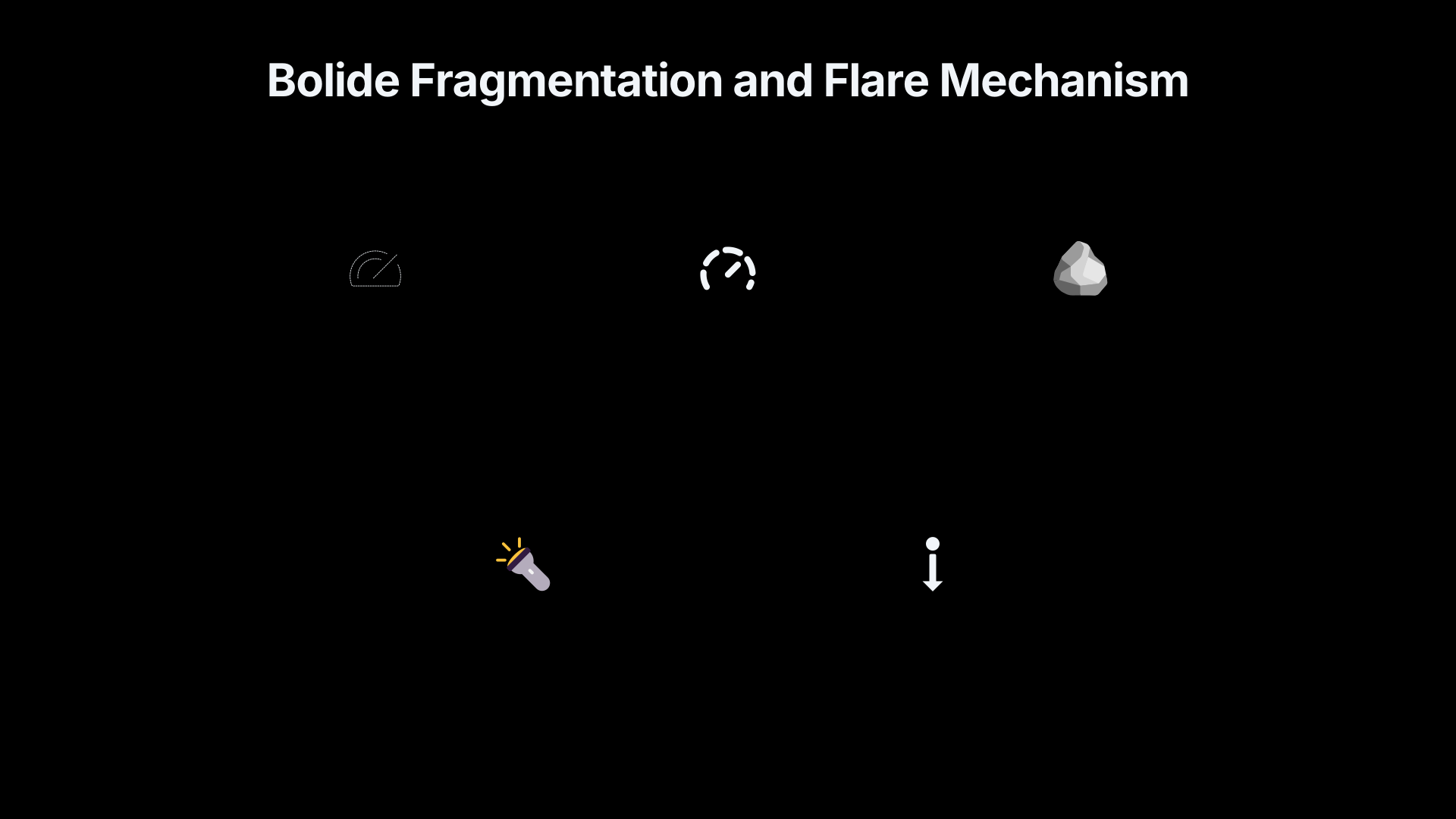
A bolide is not a solid object simply falling through the sky. As it enters the atmosphere at many kilometres per second, the pressure of compressed air in front of it rises dramatically. If the stresses exceed the object’s structural strength, it fractures. Once fragmentation begins, fresh surfaces are exposed to intense heating and ablation, often causing a sudden increase in brightness known as a terminal flare. NASA’s analysis of the Chelyabinsk event describes how fragmentation increases the area exposed to the atmosphere, accelerating energy release and producing the brightest stage of the fireball.[NASA Jet Propulsion Laboratory (JPL)]jpl.nasa.govJet Propulsion Laboratory (JPL)Additional Details on the Large Feb15 Fireball over RussiaFebruary 15, 2013 — 15 Feb 2013 — A meteor seen flying over Russia on Feb. 15 at 3:20: 26 UTC impacted Chelyabinsk…
To a ground observer, the sequence can be misleading. The meteor appears to descend, then suddenly blossoms into an intense flash. Human perception tends to treat this brightest moment as the endpoint of the object’s journey. In reality, the flare may occur tens of kilometres above the Earth’s surface. Chelyabinsk reached peak brightness at roughly 23 kilometres altitude, while modelling indicates major fragmentation occurred even higher, around 30 kilometres.[nasa.gov]jpl.nasa.govJet Propulsion Laboratory (JPL)Additional Details on the Large Feb15 Fireball over RussiaFebruary 15, 2013 — 15 Feb 2013 — A meteor seen flying over Russia on Feb. 15 at 3:20: 26 UTC impacted Chelyabinsk…
The visual impression of a crash is strengthened because the flare often overwhelms the observer’s ability to judge distance. A brilliant atmospheric explosion near the horizon can appear much closer than it really is, especially when there are no reliable reference points.
How Breakup Creates Falling-Piece Reports
Fragmentation does more than create a flash. It can also produce the appearance of multiple objects descending separately. Witnesses frequently report seeing glowing fragments peel away from the main body, sometimes describing them as pieces falling into nearby woods, fields, or hillsides.
These observations are often genuine descriptions of what was seen. The difficulty lies in interpreting what those glowing fragments represent. During breakup, multiple incandescent pieces can continue along related trajectories while still high in the atmosphere. Because observers cannot easily estimate altitude, the fragments may seem to be dropping directly into the local landscape even when they remain many kilometres above it.[DigitalCommons]digitalcommons.unl.eduFireball dynamics and orbit from radar, video, and infrasound…by P Brown · 2011 · Cited by 93 — meteorite fragments fall…
Another source of confusion is the transition from bright flight to dark flight. Once fragments slow sufficiently, they stop glowing and become effectively invisible. Meteorite recovery specialists distinguish between the luminous phase and the later “dark flight” phase, during which surviving stones fall under gravity and atmospheric drag. The visible fireball may end long before any surviving material reaches the ground.[oup.com]academic.oup.comOUP AcademicDetermination of strewn fields for meteorite fallsby J Moilanen · 2021 · Cited by 61 — A bright meteor, called a fireball, ma…
For witnesses, however, the disappearance of the glowing object is often interpreted as the moment it hit the Earth. A bright flare, followed by fading fragments and then silence, can easily create a compelling impression of a local impact even when the actual surviving debris falls elsewhere—or when no meteorites survive at all.
In the context of Kecksburg, this mechanism helps explain how multiple observers could honestly report an explosion, descending fragments, or an apparent crash site. Such reports are consistent with known bolide behaviour and do not by themselves establish that a large object reached the ground near the place where it appeared to disappear.
Why Sound Makes the Illusion Stronger
Fragmentation flares are frequently accompanied by shock waves and sonic booms. These sounds do not arrive immediately. Because sound travels far more slowly than light, witnesses may see the flash and then hear a boom many seconds or even minutes later.
This delay can reinforce the belief that an impact has occurred. A witness sees a brilliant terminal flare near the horizon, assumes the object has struck the ground, and then hears a loud rumble. The sequence feels exactly like an explosion at the perceived crash location.
Modern fireball records repeatedly show this pattern. NASA’s catalogue of meteorite falls and major fireballs contains numerous examples where fragmentation events produced sonic booms and widespread reports of impacts, even though the principal energy release occurred high in the atmosphere.[ARES]ares.jsc.nasa.govMeteorite Falls | Recent EventsThis is recorded as American Meteor Society event number 4942 for 2022.It was a daytime fireball and m…
The combination of bright flash, apparent falling pieces, and delayed sound is therefore a powerful generator of false impact impressions.
Chelyabinsk as a Modern Comparison
The 2013 Chelyabinsk superbolide provides an unusually well-documented example of how fragmentation can create misleading eyewitness impressions. Thousands of videos, satellite observations, infrasound records, and scientific studies allow researchers to reconstruct what happened with exceptional precision.
The object fragmented catastrophically high above Russia, producing a brilliant atmospheric explosion and a powerful shock wave. Many observers initially believed they had witnessed an impact. Yet the brightest flare occurred at altitude, not on the ground. Most of the object’s mass was destroyed during atmospheric breakup. Only a small fraction survived as meteorites. Phys.org+3NASA Jet Propulsion Laboratory (JPL)+3Wikipedia[jpl.nasa.gov]jpl.nasa.govJet Propulsion Laboratory (JPL)Additional Details on the Large Feb15 Fireball over RussiaFebruary 15, 2013 — 15 Feb 2013 — A meteor seen flying over Russia on Feb. 15 at 3:20: 26 UTC impacted Chelyabinsk…
Importantly, the event generated exactly the kinds of reports often associated with alleged crash incidents:
- Witnesses described explosions in the sky.
- Many reported seeing multiple fragments.
- Shock waves rattled buildings and broke windows.
- Early rumours circulated about impact locations.
- Actual meteorite recoveries occurred only after detailed investigation.[nasa.gov]jpl.nasa.govJet Propulsion Laboratory (JPL)Additional Details on the Large Feb15 Fireball over RussiaFebruary 15, 2013 — 15 Feb 2013 — A meteor seen flying over Russia on Feb. 15 at 3:20: 26 UTC impacted Chelyabinsk…
Because Chelyabinsk was instrumentally recorded, researchers can separate perception from physical reality. The case demonstrates that dramatic atmospheric fragmentation can convincingly imitate a ground impact even when the decisive event occurred tens of kilometres overhead.

What This Means for Kecksburg
The value of the terminal-flare explanation is not that it proves exactly what happened near Kecksburg. Rather, it shows that reports of an explosion, a bright final flash, or apparent falling pieces are not automatically evidence of a crashed craft or large object on the ground.
Modern observations reveal that bolides frequently end their visible flight with a fragmentation flare. That flare can appear to mark a crash site, generate reports of descending debris, and be followed by sounds that seem to confirm an impact. Yet the actual energy release may have occurred high in the atmosphere, with surviving fragments entering an unseen dark flight or never reaching the ground at all. American Meteor Society+3NASA Jet Propulsion Laboratory (JPL)+3OUP Academic[jpl.nasa.gov]jpl.nasa.govJet Propulsion Laboratory (JPL)Additional Details on the Large Feb15 Fireball over RussiaFebruary 15, 2013 — 15 Feb 2013 — A meteor seen flying over Russia on Feb. 15 at 3:20: 26 UTC impacted Chelyabinsk…
Seen through this lens, eyewitness accounts from Kecksburg become easier to understand. People may have accurately described what they observed—a brilliant flash, apparent fragments, and explosive sounds—while still being mistaken about the location and nature of the event that produced them.
eBay marketplace picks
Marketplace Samples
Live-tested eBay searches with available results related to this page.


Endnotes
1.
Source: jpl.nasa.gov
Title: Jet Propulsion Laboratory (JPL)Additional Details on the Large Feb
Link:https://www.jpl.nasa.gov/news/additional-details-on-the-large-feb-15-fireball-over-russia/
Source snippet
15 Fireball over RussiaFebruary 15, 2013 — 15 Feb 2013 — A meteor seen flying over Russia on Feb. 15 at 3:20: 26 UTC impacted Chelyabinsk...
Published: February 15, 2013
2.
Source: phys.org
Title: 2013 11 results russian chelyabinsk meteor published
Link:https://phys.org/news/2013-11-results-russian-chelyabinsk-meteor-published.html
Source snippet
First study results of Russian Chelyabinsk meteor published6 Nov 2013 — "Our meteoroid entry modeling showed that the impact was caused b...
3.
Source: Wikipedia
Title: Chelyabinsk meteor
Link:https://en.wikipedia.org/wiki/Chelyabinsk_meteor
Source snippet
Chelyabinsk meteorThe explosion generated a bright flash, producing a hot cloud of dust and gas that penetrated to 26 kilometres (16 m...
4.
Source: academic.oup.com
Link:https://academic.oup.com/mnras/article/503/3/3337/6155056
Source snippet
OUP AcademicDetermination of strewn fields for meteorite fallsby J Moilanen · 2021 · Cited by 61 — A bright meteor, called a fireball, ma...
5.
Source: researchgate.net
Title: Observations from these networks cover the bright flight, ground
Link:https://www.researchgate.net/publication/358755684_Dark-flight_Estimates_of_Meteorite_Fall_Positions_Issues_and_a_Case_Study_Using_the_Murrili_Meteorite_Fall
Source snippet
ResearchGate(PDF) Dark-flight Estimates of Meteorite Fall Positions17 Jan 2026 — Fireball networks are used to recover meteorites, with t...
6.
Source: ares.jsc.nasa.gov
Link:https://ares.jsc.nasa.gov/meteorite-falls/events/
Source snippet
Meteorite Falls | Recent EventsThis is recorded as American Meteor Society event number 4942 for 2022.It was a daytime fireball and m...
7.
Source: digitalcommons.unl.edu
Link:https://digitalcommons.unl.edu/cgi/viewcontent.cgi?article=1090&context=usafresearch
Source snippet
Fireball dynamics and orbit from radar, video, and infrasound...by P Brown · 2011 · Cited by 93 — meteorite fragments fall...
8.
Source: amsmeteors.org
Link:https://www.amsmeteors.org/fireballs/faqf/
Source snippet
American Meteor SocietyFireball FAQsGenerally speaking, a fireball must be greater than about magnitude -8 to -10 in order to potentially...
9.
Source: amsmeteors.org
Link:https://www.amsmeteors.org/
Source snippet
American Meteor SocietyThe American Meteor Society, Ltd. is established to inform, encourage, and support the research activities of peop...
10.
Source: amsmeteors.org
Link:https://www.amsmeteors.org/videos/?video_id=22126
Source snippet
AMS event #3798-2026Our affiliates observe, monitor, collect data on, study, and report on meteors, meteor showers, fireballs, and relate...
11.
Source: youtube.com
Link:https://www.youtube.com/watch?v=TuZ-TP0UN30
Source snippet
American Meteor Society on rare 'bolide' fireball seen across...AMS Operations Manager Mike Hankey speaks with 11Alive Meteorologist Mel...
12.
Source: spacesafetymagazine.com
Title: american meteor society straightens space rocks
Link:https://www.spacesafetymagazine.com/space-hazards/meteorite/american-meteor-society-straightens-space-rocks/
Source snippet
American Meteor Society Straightens Out the Space Rocks –26 Mar 2013 — The biggest of seven major chunks that the celestial body fragment...
13.
Source: ebsco.com
Link:https://www.ebsco.com/research-starters/science/bolide
Source snippet
Bolide | Science | Research StartersA bolide is a type of celestial object that enters Earth's atmosphere, typically originating from one...
Additional References
14.
Source: ftp.dutch-meteor-society.nl
Link:https://ftp.dutch-meteor-society.nl/Publications-General/Zdar_MAPS_arXiv.pdf
Source snippet
Žďár nad Sázavou meteorite fall: Fireball trajectory...by P Spurný · Cited by 45 — During the atmospheric entry, the meteoroid severely...
15.
Source: forbes.com
Title: nasa surprised by chelyabinsk russian meteor fragments
Link:https://www.forbes.com/sites/brucedorminey/2015/03/21/nasa-surprised-by-chelyabinsk-russian-meteor-fragments/
Source snippet
21 Mar 2015 — The meteor, which initially exploded in the Russian atmosphere at some 29 km in altitude, wreaked widespread destruction an...
16.
Source: ogleearth.com
Link:https://ogleearth.com/2013/02/reconstructing-the-chelyabinsk-meteors-path-with-google-earth-youtube-and-high-school-math/comment-page-2/
Source snippet
Reconstructing the Chelyabinsk meteor's path, with Google...16 Feb 2013 — We know a fragment of the meteor landed in Lake Chebarkul, rou...
17.
Source: instagram.com
Link:https://www.instagram.com/p/DYPcXGyiaL6/?hl=de&img_index=2
Source snippet
We are surprisingly bad at detecting asteroids. Asteroids Only...
18.
Source: instagram.com
Link:https://www.instagram.com/reel/DWHV2A-hSrP/?hl=en
Source snippet
County in the McDonough Blacksville area of the county and our...
19.
Source: donmachholz.com
Link:https://donmachholz.com/wp-content/uploads/2020/01/Formation-and-Past-Evolution-of-the-Meteoroid-Complex-of-Comet-96P_Machholz.pdf
Source snippet
Earth's atmosphere and exploded at an altitude of ≈ 30 km over the Russian city of Chelyabinsk. Over 1000...
20.
Source: instagram.com
Link:https://www.instagram.com/p/DVtCGQxggKk/?hl=en-gb
Source snippet
reached the ground. No injuries were reported...
21.
Source: reddit.com
Link:https://www.reddit.com/r/meteorites/comments/1s3c3b8/the_american_meteor_society_attempts_to_answer/
Source snippet
ts is not dramatically unusual.Read more...
22.
Source: youtube.com
Link:https://www.youtube.com/watch?v=3dHn_VpQhoc
Source snippet
Massive Meteor Blast Over Massachusetts — NASA Confirms 300 Tons of TNT | Viral Footage...
23.
Source: youtube.com
Link:https://www.youtube.com/watch?v=Y-e6xyUZLLs
Source snippet
uring about 1500 people from flying glass. It struck without...
Topic Tree