Within Moon Dust
When Debris Became More Interesting Later
The New Zealand Moon Dust material shows how ordinary-looking fragments could gain importance after laboratory study.
On this page
- Why the New Zealand samples stood out
- What classification suggests and does not prove
- How delayed analysis changes debris stories
Page outline Jump by section
Introduction
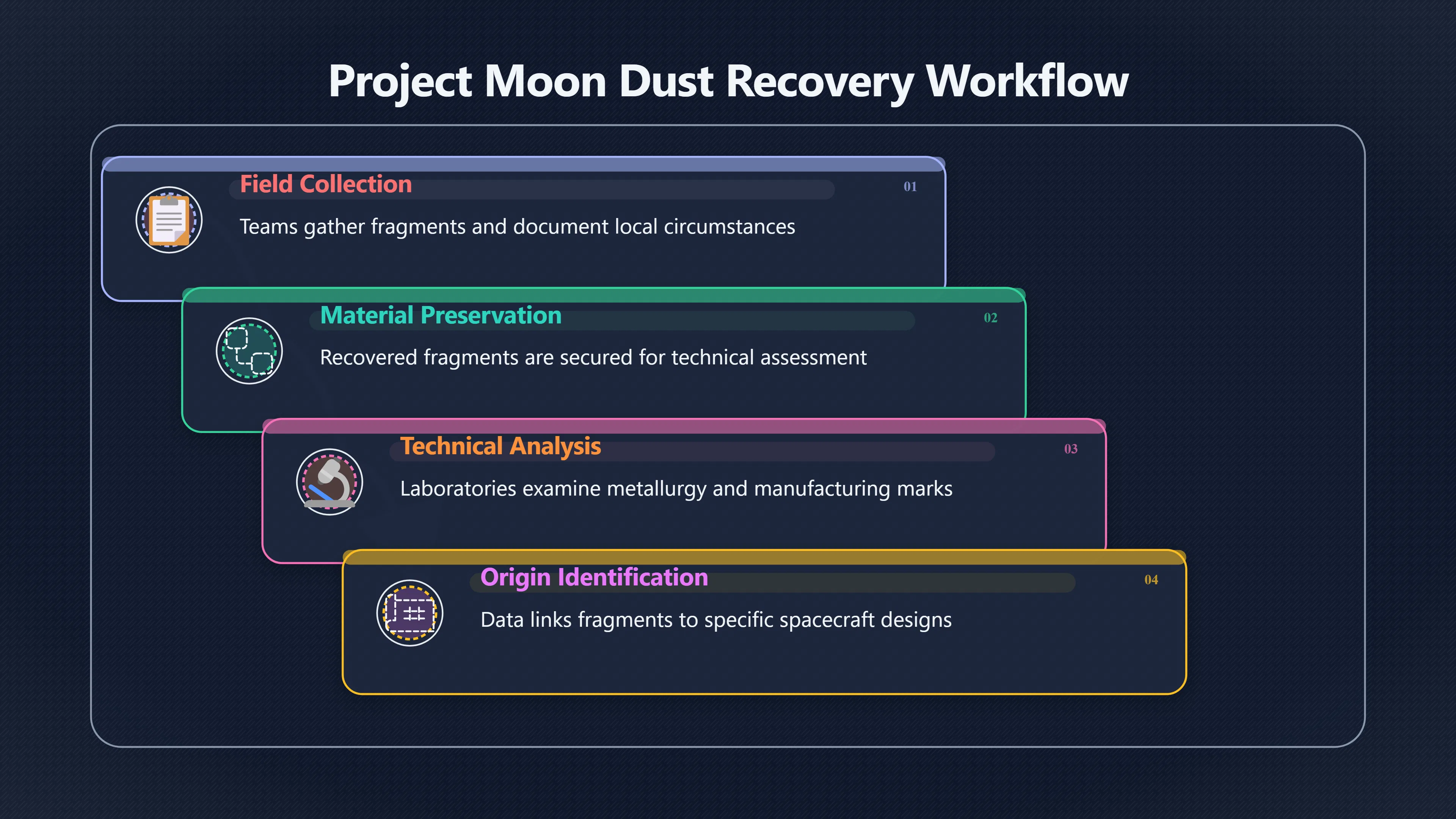
Within the broader history of Project Moon Dust, the New Zealand debris cases are noteworthy because they illustrate a recurring Cold War pattern: fragments that appeared unremarkable when first recovered could become significantly more interesting after laboratory examination. The surviving records do not show that every New Zealand find represented a major intelligence breakthrough. What they do show is a method. Material was collected, documented, forwarded for technical assessment, and in some cases treated as information whose significance could not be determined at the recovery site alone. That lesson matters when considering later debates around recovered objects, including those connected to the Kecksburg incident. A fragment’s importance often emerged from analysis rather than appearance.[governmentattic.org]governmentattic.orgProjMoondust1967 19724, 2024 — 3 Jun 2024 — Department of State (DOS) Communications Regarding. Recovery of Deorbited Space Debris (Moon Dust), 1967-. 1972. S…
Why the New Zealand Samples Stood Out
Declassified State Department communications concerning Moon Dust operations between 1967 and 1972 identify New Zealand as one of several countries involved in the recovery and reporting of suspected space debris. The documents place New Zealand alongside locations such as Nepal, Mexico and the United Kingdom in a network through which recovered material could be examined and, when necessary, shared with American authorities for identification and technical assessment.[governmentattic.org]governmentattic.orgProjMoondust1967 19724, 2024 — 3 Jun 2024 — Department of State (DOS) Communications Regarding. Recovery of Deorbited Space Debris (Moon Dust), 1967-. 1972. S…
What makes the New Zealand material particularly useful as a case study is not that the fragments were visually spectacular. Rather, officials treated them as potentially valuable evidence despite uncertainty about their origin. During the Cold War, even a scorched fragment could provide clues about manufacturing techniques, metallurgy, heat shielding, structural design or launch hardware. The fact that an object had survived re-entry already made it worthy of closer examination because relatively little foreign space hardware became available for direct inspection.[governmentattic.org]governmentattic.orgProjMoondust1967 19724, 2024 — 3 Jun 2024 — Department of State (DOS) Communications Regarding. Recovery of Deorbited Space Debris (Moon Dust), 1967-. 1972. S…
The New Zealand examples therefore reveal an important operational assumption behind Moon Dust: recovery teams were not expected to make definitive identifications in the field. Their task was to preserve material, document circumstances and pass the samples into a system capable of technical evaluation.[governmentattic.org]governmentattic.orgProjMoondust1967 19724, 2024 — 3 Jun 2024 — Department of State (DOS) Communications Regarding. Recovery of Deorbited Space Debris (Moon Dust), 1967-. 1972. S…
What Classification Suggests and Does Not Prove
Why Some Debris Findings Entered Restricted Channels
One reason Moon Dust has attracted lasting attention is that some recovered material was handled through classified or restricted reporting channels. In the context of the late 1960s and early 1970s, this was not inherently mysterious. Foreign space hardware could possess intelligence value, particularly if it originated from Soviet programmes. Technical examination might reveal engineering choices that were otherwise difficult to observe directly.[governmentattic.org]governmentattic.orgProjMoondust1967 19724, 2024 — 3 Jun 2024 — Department of State (DOS) Communications Regarding. Recovery of Deorbited Space Debris (Moon Dust), 1967-. 1972. S…
Classification therefore suggests that officials believed information had potential value. It does not automatically indicate extraordinary technology, a secret weapons system, or a non-human origin. A routine satellite component could justify restricted handling if it offered insight into a foreign aerospace programme. The surviving Moon Dust records consistently support this more conservative interpretation.[governmentattic.org]governmentattic.orgProjMoondust1967 19724, 2024 — 3 Jun 2024 — Department of State (DOS) Communications Regarding. Recovery of Deorbited Space Debris (Moon Dust), 1967-. 1972. S…
The Gap Between Secrecy and Proof
The New Zealand material is a useful reminder that secrecy and significance are not the same thing. Many later UFO narratives have treated any classified debris analysis as evidence that authorities had discovered something extraordinary. The documentary record supports a narrower conclusion: governments frequently classified information simply because they wanted to understand another nation’s technology before discussing it publicly.[governmentattic.org]governmentattic.orgProjMoondust1967 19724, 2024 — 3 Jun 2024 — Department of State (DOS) Communications Regarding. Recovery of Deorbited Space Debris (Moon Dust), 1967-. 1972. S…
In other words, classification can indicate interest, uncertainty or intelligence value. By itself, it cannot establish what the recovered object actually was.
How Delayed Analysis Changes Debris Stories
The most important lesson from the New Zealand samples is methodological. Initial observations often provide only a partial picture. Burned surfaces, fragmented structures and missing components can make identification difficult at the recovery scene. Laboratory work allows investigators to compare alloys, examine manufacturing marks, analyse structural characteristics and relate fragments to known spacecraft designs.[governmentattic.org]governmentattic.orgProjMoondust1967 19724, 2024 — 3 Jun 2024 — Department of State (DOS) Communications Regarding. Recovery of Deorbited Space Debris (Moon Dust), 1967-. 1972. S…
This process can substantially alter the narrative surrounding a recovered object. A fragment first regarded as unidentified may later be linked to a specific satellite, rocket stage or spacecraft component. Conversely, an apparently mundane object can gain significance once its origin is established. The value lies not in the fragment’s appearance but in what technical analysis reveals about it.[governmentattic.org]governmentattic.orgProjMoondust1967 19724, 2024 — 3 Jun 2024 — Department of State (DOS) Communications Regarding. Recovery of Deorbited Space Debris (Moon Dust), 1967-. 1972. S…
International records of recovered space objects demonstrate this broader principle. Numerous debris finds remained uncertain until comparative analysis connected them with known launches and spacecraft. The United Nations’ long-running catalogue of recovered space objects reflects the importance of post-recovery identification rather than immediate visual judgement.[UNOOSA]unoosa.orgNumber, Date of Discovery, Notifying State, Document Symbol, Location of Discovery, Physical…Read more…
What the New Zealand Case Means for Kecksburg Context
For readers examining the Kecksburg controversy through the lens of Project Moon Dust, the New Zealand samples offer a valuable point of comparison. They show that officials involved with debris recovery did not necessarily reach conclusions where an object landed. Instead, they often treated recovered material as evidence requiring specialist examination.[governmentattic.org]governmentattic.orgProjMoondust1967 19724, 2024 — 3 Jun 2024 — Department of State (DOS) Communications Regarding. Recovery of Deorbited Space Debris (Moon Dust), 1967-. 1972. S…
That does not establish any connection between the New Zealand recoveries and Kecksburg, nor does it demonstrate that a recovered Kecksburg object entered a similar analytical pipeline. The significance lies elsewhere. The New Zealand records document a real-world process in which uncertain fragments were collected first and understood later. They illustrate how Cold War debris investigations frequently depended on laboratory assessment, technical expertise and classified reporting before any confident identification could be made.[governmentattic.org]governmentattic.orgProjMoondust1967 19724, 2024 — 3 Jun 2024 — Department of State (DOS) Communications Regarding. Recovery of Deorbited Space Debris (Moon Dust), 1967-. 1972. S…
Seen in that light, the New Zealand samples are less important for what they conclusively identified than for what they reveal about recovery practice itself: in the Moon Dust era, debris often became more interesting after analysis than it appeared at the moment of discovery.[governmentattic.org]governmentattic.orgProjMoondust1967 19724, 2024 — 3 Jun 2024 — Department of State (DOS) Communications Regarding. Recovery of Deorbited Space Debris (Moon Dust), 1967-. 1972. S…
Amazon book picks
Further Reading
Books and field guides related to When Debris Became More Interesting Later. Use these as the next step if you want deeper reading beyond the article.
The Hunt for Zero Point
Explores how unusual aerospace materials can gain significance after analysis.
eBay marketplace picks
Marketplace Samples
Live-tested eBay searches with available results related to this page.


Endnotes
1.
Source: governmentattic.org
Title: ProjMoondust1967 1972
Link:https://www.governmentattic.org/54docs/ProjMoondust1967-1972.pdf
Source snippet
4, 2024 — 3 Jun 2024 — Department of State (DOS) Communications Regarding. Recovery of Deorbited Space Debris (Moon Dust), 1967-. 1972. S...
2.
Source: unoosa.org
Link:https://www.unoosa.org/oosa/en/treatyimplementation/arra-art-v/unlfd.html
Source snippet
Number, Date of Discovery, Notifying State, Document Symbol, Location of Discovery, Physical...Read more...
3.
Source: unoosa.org
Title: 5 New Zealand
Link:https://www.unoosa.org/documents/pdf/copuos/stsc/2025/Statements/5_New_Zealand.pdf
Source snippet
New Zealand, Item 5: Space Debris3 Feb 2025 — Requiring an orbital debris mitigation plan is intended to limit the proliferation of space...
4.
Source: youtube.com
Title: The Kecksburg Incident: What Really Happened Here?
Link:https://www.youtube.com/watch?v=BXh2zTD9Kug
Source snippet
Project Moon Dust | Episode 8 | The Secret UFO Retrieval Program...
5.
Source: youtube.com
Title: Project Moon Dust | Episode 8 | The Secret UFO Retrieval Program
Link:https://www.youtube.com/watch?v=uKAT4yK_AyY
Source snippet
America's Other Roswell: the Kecksburg UFO | Conspiracy (S1, E13) | Full Episode | History...
6.
Source: pmcsa.ac.nz
Link:https://www.pmcsa.ac.nz/2024/02/08/space/
Source snippet
Navigating the complexities of pollution from the space industry8 Feb 2024 — Measuring pollution produced by the space sector can be quit...
7.
Source: lumebooks.co.uk
Title: project moon dust
Link:https://www.lumebooks.co.uk/book/project-moon-dust/
Source snippet
Beyond RoswellIn 1953, a classified government project was proposed, that would deal with the recovery of 'returning space debris' launch...
Additional References
8.
Source: nzsis.govt.nz
Link:https://www.nzsis.govt.nz/information-releases/declassified-historical-records
Source snippet
Declassified historical recordsWe hold the records of all the organisations that have been responsible for New Zealand's security intelli...
9.
Source: Wikipedia
Link:https://en.wikipedia.org/wiki/Project_Moon_Dust
Source snippet
Project Moon DustThe aim of the project was to recover objects and debris from spacecraft that survived re-entry through the atmospher...
10.
Source: reddit.com
Link:https://www.reddit.com/r/UFOs/comments/oa9mux/project_moon_dust_crashed_ufo_retrieval_program/
Source snippet
Project Moon Dust: Crashed Ufo retrieval program: r/UFOsThe Wikipedia page states that the goal of the program was to "recover objects a...
11.
Source: environment.govt.nz
Link:https://environment.govt.nz/assets/Publications/Files/Ecological-Risk-Assessment-of-the-impact-of-debris-from-space-launches-on-the-marine-environment.pdf
Source snippet
Ecological-Risk-Assessment-of-the-impact-of-debris-from-...2012) as a basis to segment New Zealand's EEZ and ECS into a workable number...
12.
Source: GOV.UK
Title: uk and new zealand agree blueprint for satellite removal and servicing missions
Link:https://www.gov.uk/government/news/uk-and-new-zealand-agree-blueprint-for-satellite-removal-and-servicing-missions
Source snippet
and New Zealand agree blueprint for satellite removal...17 Oct 2024 — There is an urgent need to invest in new technologies that can hel...
13.
Source: researchgate.net
Link:https://www.researchgate.net/publication/268982780_THE_STATE_OF_DECONSTRUCTION_IN_NEW_ZEALAND
Source snippet
It outlines specific circumstances in New Zealand which affect deconstruction and materials...Read more...
14.
Source: archives.govt.nz
Link:https://www.archives.govt.nz/
Source snippet
Archives New Zealand: HomeFind out what kinds of archive we hold, get research advice or use our guides to discover how to find records o...
15.
Source: innovationnewsnetwork.com
Title: uk and new zealand partner on space debris removal
Link:https://www.innovationnewsnetwork.com/uk-and-new-zealand-partner-on-space-debris-removal/52004/
Source snippet
17 Oct 2024 — The UK and New Zealand space agencies are enhancing space sustainability by signing a new agreement focused on space debris...
16.
Source: haveyoursay.ecan.govt.nz
Link:https://haveyoursay.ecan.govt.nz/72485/widgets/435887/documents/285436
Source snippet
best practice for quarry dust management in New...6 Mar 2024 — Dust particles vary greatly in diameters, from approximately 100 µm to le...
17.
Source: leonarddavid.com
Title: secretive project moon dust details revealed
Link:https://www.leonarddavid.com/secretive-project-moon-dust-details-revealed/
Source snippet
Secretive Moon Dust Details Revealed3 Jun 2024 — New revelations have come to light regarding Project Moon Dust, long known by Freedom of...
Topic Tree