Within Moon Dust
What Cosmos 316 Reveals About Fallen Satellites
The Cosmos 316 case shows how large Soviet fragments could be recovered, identified, legally managed, and publicly framed.
On this page
- What fell across the Midwest
- How officials identified and handled the fragments
- Why display wording and custody mattered
Page outline Jump by section
Introduction
The recovery of fragments from the Soviet satellite Cosmos 316 is one of the clearest documented examples of how Cold War governments handled fallen space hardware. For students of the Kecksburg incident and Project Moon Dust, the case is valuable because it shows what happened when a large, identifiable foreign space object actually fell across the United States. The resulting paper trail reveals not only how debris was recovered and identified, but also a less obvious problem: once officials possessed the material, how should it be described, displayed, and legally managed in public? The answers illuminate the practical realities of space-debris recovery far better than speculation about secret retrievals.[governmentattic.org]governmentattic.orgProjMoondust1967 19724, 2024 — 3 Jun 2024 — The Department of State has physical custody of the Soviet space fragments, Six fragments were recovered by the Un…

What Fell Across the Midwest
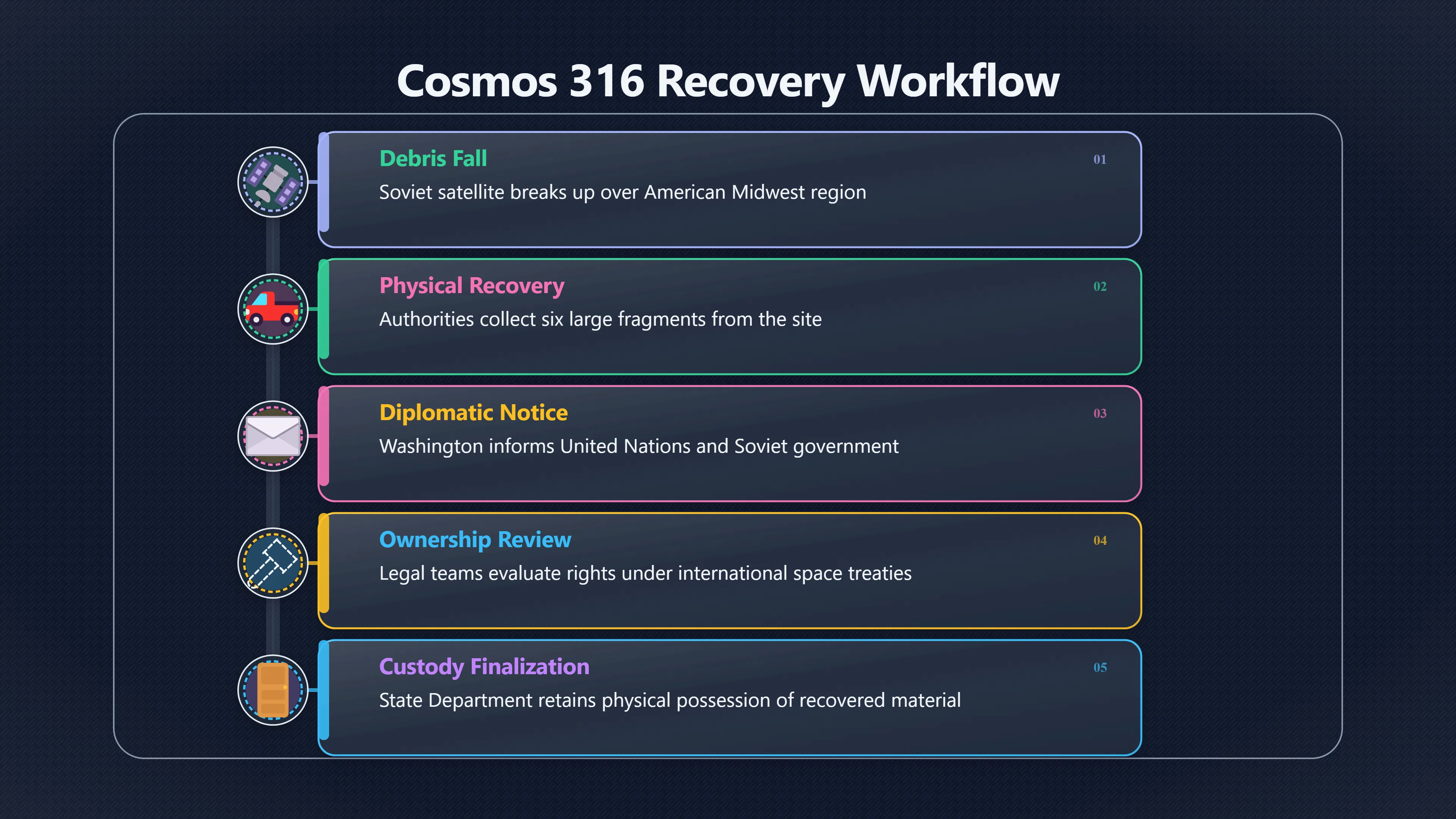
On 28 August 1970, the Soviet satellite Cosmos 316 broke up during re-entry, scattering debris across a broad area of the American Midwest. United States authorities ultimately recovered six fragments. According to State Department records, the largest recovered piece measured roughly four feet by four feet and weighed about 640 pounds, making it a substantial artefact rather than a small scrap of metal.[governmentattic.org]governmentattic.orgProjMoondust1967 19724, 2024 — 3 Jun 2024 — The Department of State has physical custody of the Soviet space fragments, Six fragments were recovered by the Un…
The event created exactly the kind of situation that Project Moon Dust had been designed to address. A foreign space object had entered the atmosphere, pieces survived to the ground, and government agencies needed to determine what had fallen, who owned it, and what should be done with it. Unlike many later UFO-related claims, the Cosmos 316 case involved tangible objects that could be examined directly.[governmentattic.org]governmentattic.orgProjMoondust1967 19724, 2024 — 3 Jun 2024 — The Department of State has physical custody of the Soviet space fragments, Six fragments were recovered by the Un…
The recovery also occurred during a period when international space law was still developing. Governments were attempting to establish practical procedures for the return, identification, and liability of space objects. A recovered Soviet satellite fragment was therefore not merely a curiosity; it had diplomatic and legal significance.[governmentattic.org]governmentattic.orgProjMoondust1967 19724, 2024 — 3 Jun 2024 — The Department of State has physical custody of the Soviet space fragments, Six fragments were recovered by the Un…
How Officials Identified and Handled the Fragments
The United States followed the procedures established under the 1968 Agreement on the Rescue of Astronauts, the Return of Astronauts and the Return of Objects Launched into Outer Space. After the fragments were recovered, Washington informed both the United Nations Secretary-General and the Soviet government. Officials provided physical descriptions and invited Soviet representatives to inspect and claim the material if they wished.[governmentattic.org]governmentattic.orgProjMoondust1967 19724, 2024 — 3 Jun 2024 — The Department of State has physical custody of the Soviet space fragments, Six fragments were recovered by the Un…
The Soviet response proved unusual. Embassy personnel declined to inspect or claim the fragments. In a subsequent diplomatic note, the Soviet side indicated that it was not interested in pursuing further examination of the recovered objects. This left the United States in possession of material that was widely believed to be Soviet but which the presumed owner showed little interest in reclaiming.[governmentattic.org]governmentattic.orgProjMoondust1967 19724, 2024 — 3 Jun 2024 — The Department of State has physical custody of the Soviet space fragments, Six fragments were recovered by the Un…
That circumstance transformed a straightforward recovery operation into a custody problem. The fragments remained in the physical custody of the State Department while lawyers and policymakers considered ownership issues. Existing treaties suggested that a launching state retained rights over its space objects, but the Soviet refusal to claim the debris complicated the practical application of those principles.[governmentattic.org]governmentattic.orgProjMoondust1967 19724, 2024 — 3 Jun 2024 — The Department of State has physical custody of the Soviet space fragments, Six fragments were recovered by the Un…
For Moon Dust researchers, this aspect of the case is especially important. It demonstrates that recovery was only the first step. Identification, diplomatic notification, legal review, and long-term custody could take years after the actual fall of the debris.[governmentattic.org]governmentattic.orgProjMoondust1967 19724, 2024 — 3 Jun 2024 — The Department of State has physical custody of the Soviet space fragments, Six fragments were recovered by the Un…
Why Display Wording and Custody Mattered
The most revealing part of the Cosmos 316 story emerged after recovery. By 1972, American officials were considering placing the fragments on public display. The proposal involved transferring pieces to institutions such as the National Air and Space Museum and the Air Force Museum while allowing the State Department to retain legal custody and the right to recall the objects if circumstances changed.[governmentattic.org]governmentattic.orgProjMoondust1967 19724, 2024 — 3 Jun 2024 — The Department of State has physical custody of the Soviet space fragments, Six fragments were recovered by the Un…
At first glance, displaying recovered satellite debris might seem straightforward. Yet internal discussions show considerable concern about how the fragments would be presented. Officials recognised that public exhibition would implicitly communicate that the United States had identified the material as Soviet space hardware. At the same time, the government wished to avoid creating diplomatic complications or undermining ongoing discussions related to international space law and liability conventions.[governmentattic.org]governmentattic.orgProjMoondust1967 19724, 2024 — 3 Jun 2024 — The Department of State has physical custody of the Soviet space fragments, Six fragments were recovered by the Un…
The issue was therefore not simply whether the fragments should be displayed, but how they should be described. If labels overstated certainty, they could create diplomatic problems. If labels were overly cautious, they could invite criticism that the government was unable to identify obvious satellite debris. Internal memoranda specifically noted concerns that public debate over identification could become entangled with broader international discussions about how space objects should be tracked and recognised.[governmentattic.org]governmentattic.orgProjMoondust1967 19724, 2024 — 3 Jun 2024 — The Department of State has physical custody of the Soviet space fragments, Six fragments were recovered by the Un…
This was a classic Cold War public-information dilemma. The objects were real and physically available, yet their presentation carried implications extending beyond museum interpretation. Display language, ownership status, and custody arrangements all had political significance.[governmentattic.org]governmentattic.orgProjMoondust1967 19724, 2024 — 3 Jun 2024 — The Department of State has physical custody of the Soviet space fragments, Six fragments were recovered by the Un…
What the Case Reveals About Fallen Satellites
The Cosmos 316 recovery offers a documented contrast to cases where the nature of a fallen object remains disputed. Here, officials dealt with a known category of object: space debris. The surviving records show a process built around evidence, international notification, technical identification, and legal management.[governmentattic.org]governmentattic.orgProjMoondust1967 19724, 2024 — 3 Jun 2024 — The Department of State has physical custody of the Soviet space fragments, Six fragments were recovered by the Un…
Several lessons emerge:
- Recovery did not automatically settle questions of ownership.
- Foreign governments could decline to reclaim recovered hardware.
- Public display required diplomatic and legal review, not merely museum interest.
- Government agencies often retained custody rights even when artefacts were exhibited elsewhere.
- Identification and public communication were treated as separate issues requiring different decisions.[governmentattic.org]governmentattic.orgProjMoondust1967 19724, 2024 — 3 Jun 2024 — The Department of State has physical custody of the Soviet space fragments, Six fragments were recovered by the Un…
These points matter in the broader Kecksburg context because they show how authorities handled a genuine case of recovered space debris. Rather than disappearing into permanent secrecy, the Cosmos 316 fragments generated paperwork, diplomatic exchanges, debates over ownership, and discussions about museum display. The case therefore provides a grounded historical example of how recovered aerospace material could move from field recovery to public exhibition while still remaining entangled in questions of custody, attribution, and international politics.[governmentattic.org]governmentattic.orgProjMoondust1967 19724, 2024 — 3 Jun 2024 — The Department of State has physical custody of the Soviet space fragments, Six fragments were recovered by the Un…
Amazon book picks
Further Reading
Books and field guides related to What Cosmos 316 Reveals About Fallen Satellites. Use these as the next step if you want deeper reading beyond the article.
Spaceflight
Provides context for satellite programs and re-entry events like Cosmos 316.
The NASA Conspiracies
Connects public perceptions of recovered space hardware with official responses.
UFOs and the National Security State
Provides context for how recovered aerospace objects were interpreted during the Cold War.
Challenge to Apollo
Helps readers understand the Soviet satellite environment that produced Cosmos missions.
eBay marketplace picks
Marketplace Samples
Live-tested eBay searches with available results related to this page.


Endnotes
1.
Source: governmentattic.org
Title: ProjMoondust1967 1972
Link:https://www.governmentattic.org/54docs/ProjMoondust1967-1972.pdf
Source snippet
4, 2024 — 3 Jun 2024 — The Department of State has physical custody of the Soviet space fragments, Six fragments were recovered by the Un...
2.
Source: space.com
Title: failed soviet venus lander [kosmos]({{ ‘kosmos-96/’ | relative_url }}) 482 crashes to earth after 53 years in orbit
Link:https://www.space.com/space-exploration/launches-spacecraft/failed-soviet-venus-lander-kosmos-482-crashes-to-earth-after-53-years-in-orbit
Source snippet
Failed Soviet Venus lander Kosmos 482 crashes to Earth...10 May 2025 — The Soviet Union's failed Kosmos 482 Venus lander fell back to Ea...
Published: May 2025
3.
Source: youtube.com
Link:https://www.youtube.com/watch?v=tU7WSHZye5w
Source snippet
Project Moon Dust | Episode 8 | The Secret UFO Retrieval Program...
4.
Source: youtube.com
Title: Project Moon Dust | Episode 8 | The Secret UFO Retrieval Program
Link:https://www.youtube.com/watch?v=uKAT4yK_AyY
Source snippet
America's Other Roswell: the Kecksburg UFO | Conspiracy (S1, E13) | Full Episode | History...
5.
Source: abcnews.com
Link:https://abcnews.com/Technology/failed-soviet-era-spacecraft-expected-crash-back-earth/story?id=121533765
Source snippet
Failed Soviet-era spacecraft appears to have crashed back...The ESA says more than 1.2 million pieces of debris are orbiting the Earth...
6.
Source: mccrone.com
Title: moon dust
Link:https://www.mccrone.com/case-studies/moon-dust/
Source snippet
In the early 1970s, McCrone Associates, working with samples of moon dust obtained. Anorthosite fragments may show bits of plagioclase, o...
Additional References
7.
Source: unoosa.org
Link:https://www.unoosa.org/oosa/en/treatyimplementation/arra-art-v/unlfd.html
Source snippet
Recovery and Return of Objects Launched into Outer SpaceMember States provide reports of space objects discovered in territory. Con...
8.
Source: businessinsider.com
Link:https://www.businessinsider.com/flashback-soviet-satellite-exploded-scattering-nuclear-debris-over-canada
Source snippet
Soviet Satellite Crash Scattered Nuclear Debris Over...28 Dec 2023 — A Soviet nuclear-powered satellite experienced a malfunction, fell...
9.
Source: facebook.com
Title: a soviet era spacecraft fragment is expected to re enter earths atmosphere tomor
Link:https://www.facebook.com/VirginMediaNews/videos/a-soviet-era-spacecraft-fragment-is-expected-to-re-enter-earths-atmosphere-tomor/702704552697892/
Source snippet
A Soviet-era spacecraft fragment is expected to re-enter...The approaching debris was part of a Soviet era spacecraft launched in 1972 o...
10.
Source: facebook.com
Title: in the 1970s the united states gifted moon rocks and moon dust to 135 countries
Link:https://www.facebook.com/thisiscriminal/posts/in-the-1970s-the-united-states-gifted-moon-rocks-and-moon-dust-to-135-countries-/1172885714840490/
Source snippet
In the 1970s the United States gifted moon rocks and...In the 1970s the United States gifted moon rocks and moon dust to 135 countries a...
11.
Source: blogs.esa.int
Title: reentry prediction soviet era venera venus lander cosmos 482 descent craft
Link:https://blogs.esa.int/rocketscience/2025/05/07/reentry-prediction-soviet-era-venera-venus-lander-cosmos-482-descent-craft/
Source snippet
prediction Soviet-era Venera Venus lander (Cosmos...7 May 2025 — On 10 May, an uncontrolled reentry will take place of the Cosmos-482 de...
Published: May 2025
12.
Source: youtube.com
Link:https://www.youtube.com/watch?v=2iygSoC5bc8
Source snippet
The Soviet Nuclear Horror That Plummeted From OrbitOne of their stateof the-art nuclear powered satellites designed to spy on the America...
13.
Source: astronomy.com
Title: failed soviet era spacecraft returned to earth on saturday
Link:https://www.astronomy.com/space-exploration/failed-soviet-era-spacecraft-returned-to-earth-on-saturday/
Source snippet
Failed Soviet-era spacecraft returned to Earth on Saturday12 May 2025 — The remains of a Venus mission launched by the former Soviet Unio...
Published: May 2025
14.
Source: cbsnews.com
Title: spacecraft kosmos 482 plunging back earth what to know
Link:https://www.cbsnews.com/news/spacecraft-kosmos-482-plunging-back-earth-what-to-know/
Source snippet
A Soviet spacecraft is about to crash into Earth 53 years...9 May 2025 — The Soviet-era spacecraft meant to land on Venus a half century...
Published: May 2025
15.
Source: ijpr.org
Title: A woman in Illinois bought the artifact for less than
Link:https://www.ijpr.org/2017-07-20/moon-dust-bag-accidentally-in-private-hands-auctioned-for-1-5-million
Source snippet
Moon Dust Bag, Accidentally In Private Hands, Auctioned...20 Jul 2017 — NASA lost track of a bag that was used to carry samples during t...
16.
Source: news.rice.edu
Title: kosmos 482s return being watched closely rice experts
Link:https://news.rice.edu/news/2025/kosmos-482s-return-being-watched-closely-rice-experts
Source snippet
482's return being watched closely by Rice experts6 May 2025 — A fragment of a Soviet spacecraft that malfunctioned en route to Venus mor...
Published: May 2025
Topic Tree