Within Kecksburg
What Did the NASA Lawsuit Really Prove?
The NASA records battle proved flawed searches, not an alien crash, and remains crucial to the evidence trail.
On this page
- Leslie Kean's request
- Court criticism of searches
- Why missing records matter
Page outline Jump by section
Introduction
The NASA records lawsuit over the Kecksburg UFO incident did not prove that an alien craft crashed in Pennsylvania. What it did prove is narrower, but still important: NASA’s early Freedom of Information Act searches were flawed, poorly documented, and incomplete enough that a federal judge refused to accept the agency’s assurance that it had done all it reasonably could. That finding matters because Kecksburg is a case built partly on gaps — missing records, conflicting official explanations, and claims that agencies handled debris or documents that later could not be found.
The lawsuit, brought by journalist Leslie Kean after a 2003 FOIA request, turned the Kecksburg debate from a folklore-and-witness story into a governance problem: how should the public evaluate a Cold War incident when agencies cannot clearly show where they searched, what terms they used, what boxes were missing, and why potentially relevant files disappeared? The answer is not “therefore UFO”. It is “the public record was not handled well enough to settle the question cleanly”.
Leslie Kean’s Request
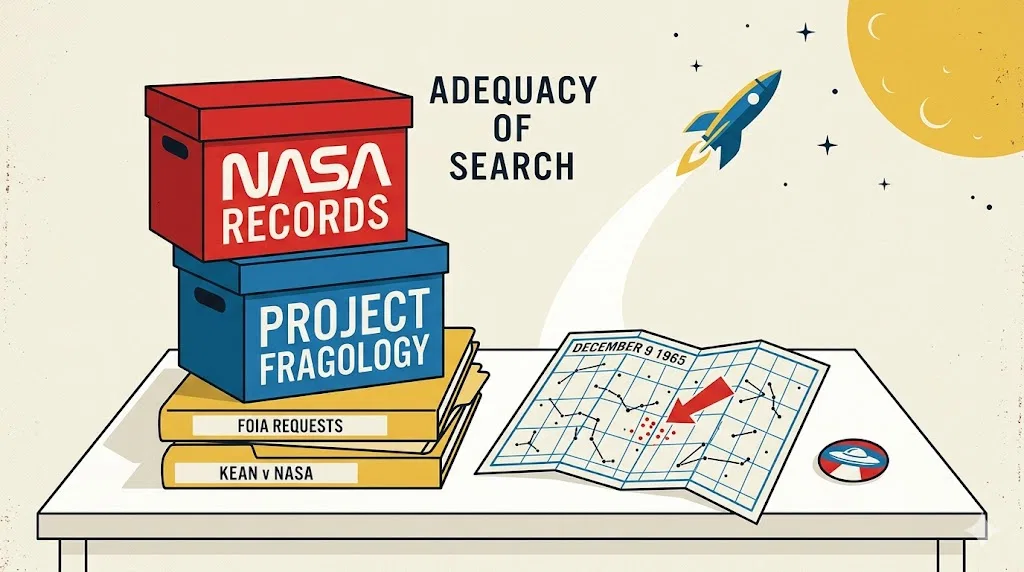
Leslie Kean’s FOIA effort began with a specific records demand, not a general request for NASA to “solve” Kecksburg. In January 2003, she asked NASA for documents related to the 9 December 1965 Kecksburg incident, including material on the so-called “Fragology Files”, Richard M. Schulherr, Project Moon Dust, and Cosmos 96. The federal court later summarised the request in exactly those terms, making clear that the lawsuit centred on record retrieval rather than on proving a particular crash theory.[The Black Vault]documents2.theblackvault.comThe Black Vault
That distinction is crucial. FOIA does not require an agency to create a new investigation or reach a scientific conclusion; it requires an agency to search for existing agency records and disclose them unless a lawful exemption applies. FOIA.gov describes the law as giving the public access to federal agency records, while allowing withholding only under recognised exemptions such as privacy, national security, and law enforcement interests.[foia.gov]foia.govFOI A.govFreedom of Information ActThe FOIA provides broad access to agency records, but not all information is appropriate for disclosure. Agenci…
Kean’s interest in NASA, rather than only the Air Force or Army, was tied to the possibility that NASA had records about orbital debris, fragment analysis, or earlier agency handling of space-object material. Contemporary reporting noted that Kean sued NASA because the agency had previously released some relevant documents and because NASA was alleged to have expertise or records connected to space debris analysis.[CBS News]cbsnews.comNASA Court-Ordered To Search For UFO Docs - CBS News…
The public controversy intensified in 2005 when a NASA spokesperson said there was no cover-up and that the object appeared to have been a Russian satellite, but that the records documenting expert findings had been misplaced. In the same report, Kean argued that NASA’s own orbital-debris specialist Nicholas L. Johnson had found that the object could not be a Russian satellite or other known human-made object, creating a public contradiction between NASA-related explanations and the available paper trail.[News24]news24.comNasa under pressure over 'UFO' | News24Nasa under pressure over 'UFO' | News24

What the Court Actually Criticised
The most important court finding was procedural. Judge Emmet G. Sullivan did not rule that Kecksburg involved extraterrestrial technology, a secret weapons system, or a Soviet probe. He ruled that NASA had not yet carried its burden of showing that its search for responsive documents was adequate. The court’s opinion states that NASA admitted its first two searches were inadequate, while the agency argued that later searches had cured the problem.[The Black Vault]documents2.theblackvault.comThe Black Vault
The court record shows why this mattered. NASA’s first search produced a “no records” response, even though an archivist had recommended sending the request to the Goddard Space Flight Center; the court noted that, for unclear reasons, this did not happen. After Kean appealed, NASA promised a wider search across all NASA centres and said it would look for the missing Fragology Files, but the court found that NASA initially failed to act properly on that promise, apparently because of poor tracking and a relocation of the FOIA office.[The Black Vault]documents2.theblackvault.comThe Black Vault
The third search was broader, but its documentation was weak. The court noted that many NASA centre responses simply asserted that a “thorough” search had been completed and that no responsive records were found. Only some responses specified actual databases, search terms, or the kinds of records searched. In other words, the problem was not just whether documents existed; it was whether NASA had created a reliable record showing how it had looked for them.[The Black Vault]documents2.theblackvault.comThe Black Vault
This is a familiar issue in FOIA litigation. The government does not win merely by saying “we looked”; it must provide enough detail to show that the search was reasonably calculated to uncover responsive records. The Department of Justice’s FOIA materials treat adequacy of search as a recurring litigation issue, and the Kecksburg opinion applied that same ordinary public-records standard to a UFO-adjacent controversy.[Department of Justice]justice.govOpen source on justice.gov.
NASA did win one part of the dispute. The judge accepted NASA’s withholding of two internal emails under FOIA Exemption 5, which protects certain deliberative or privileged internal communications. But on the central search question, NASA’s motion for summary judgment was denied in part because the agency had failed to demonstrate that its searches were adequate.[The Black Vault]documents2.theblackvault.comThe Black Vault
The Missing Boxes Problem
The most memorable part of the lawsuit is the missing-records trail. The court opinion says NASA sought nineteen boxes of archived information from the Washington National Records Center based on accession numbers supplied by Kean. Three boxes were reported as having been missing for quite some time, while the remaining sixteen were searched. In a later search, NASA re-examined those sixteen boxes and found responsive documents that had not surfaced before.[The Black Vault]documents2.theblackvault.comThe Black Vault
That detail is one reason the lawsuit remains important. If the same boxes can yield no responsive material in one search and then produce responsive material in another, the dispute shifts from “believers versus sceptics” to records management: indexing, accession numbers, search instructions, staff familiarity, and documentation quality. The lawsuit exposed a practical weakness in the evidence trail without establishing what object, if any, was recovered near Kecksburg.
The Fragology Files are especially relevant because they were described in later archival summaries as reports on recovery and analysis of space objects, including analysis of fragments to determine national ownership and vehicle origin. The Black Vault’s archive notes that NASA transferred a cache of such records in the late 1960s, that NARA later told NASA the boxes were “lost” and marked as such by 1987, and that the hunt for those records helped generate Kean v NASA.[The Black Vault]theblackvault.comOpen source on theblackvault.com.
Later releases did not simply close the matter. In 2021, NASA released more than 220 pages related to the Kean v NASA lawsuit, including communications from the case and material connected to Project Moon Dust, a government activity associated with recovery or examination of foreign or unidentified space-object debris. The same archive notes that other records had been destroyed under NASA retention schedules, which is not necessarily sinister but does limit what later researchers can reconstruct.[The Black Vault]theblackvault.comOpen source on theblackvault.com.
Why the Lawsuit Did Not Prove an Alien Crash
The lawsuit is sometimes treated online as if Kean “won” the Kecksburg case in the sense of proving a hidden recovery. That overstates the record. What she won was a transparency fight: the court required better search and documentation procedures, NASA agreed to conduct a more comprehensive search, and the agency reportedly agreed to pay legal fees. The Reporters Committee for Freedom of the Press described the outcome as NASA being required to conduct a thorough agency-file search after years of dispute, not as a judicial finding about what fell in Pennsylvania.[Reporters Committee]rcfp.orgOpen source on rcfp.org.
Reporting at the time captured the same point. CBS News, citing Associated Press reporting, said NASA agreed to search its archives again after fighting the issue in federal court. Kean framed the case as a public right-to-know matter, while the article noted that eyewitnesses, Air Force explanations, and reports of NASA employees at the scene remained in tension.[CBS News]cbsnews.comNASA Court-Ordered To Search For UFO Docs - CBS News…
The later document haul also failed to produce a “smoking gun”. Space.com’s 2009 account of Kean’s post-lawsuit report said the court-monitored search was completed in August 2009 and that no smoking-gun documents were released, although Kean argued that missing or destroyed files and unresolved contradictions remained significant.[Space]space.com7589 case finally closed 1965 pennsylvania ufo mystery7589 case finally closed 1965 pennsylvania ufo mystery
That is the balanced reading: the lawsuit strengthened the case that the government record was mishandled or inadequately searched, but it did not supply a verified object, chain of custody, laboratory report, recovery inventory, or conclusive agency admission that a craft was taken from Kecksburg. A transparency failure can keep a mystery alive without proving the most dramatic explanation.
Why Missing Records Still Matter
Missing records matter because they change the burden of interpretation. In a well-preserved incident file, researchers can compare eyewitness statements, search logs, military movements, technical analyses, and official conclusions. In Kecksburg, the record is fragmented enough that both sceptics and proponents can point to gaps: sceptics can say no recovered object has been documented, while proponents can say the absence of key records is itself suspicious.
The governance lesson is more durable than the UFO claim. NASA’s difficulties showed how old records can become effectively inaccessible through weak indexing, office moves, vague search instructions, staff turnover, retention schedules, and unclear custody between agencies and archives. None of those mechanisms requires a cover-up. But together they can produce the public effect of one: citizens ask a clear question and receive an answer that cannot be independently checked.
The lawsuit also explains why Kecksburg remains a records case as much as a witness case. If the missing Fragology material had contained routine debris reports, it might have narrowed the field of plausible explanations. If it had contained nothing about Kecksburg, that too would have mattered. If it had contained references to Cosmos 96, Project Moon Dust, or domestic recovery teams, it could have clarified whether NASA’s later satellite explanation had any documentary foundation. Because the most relevant records were missing, destroyed, or only partially recovered, each possibility remains weaker than a documented conclusion would be.
This is why the NASA records fight belongs at the centre of the Kecksburg evidence trail. It does not transform the incident into proof of an alien crash. It shows that the official archival trail was too damaged and poorly documented to resolve the controversy with the confidence the public was entitled to expect.

Amazon book picks
Further Reading
Books and field guides related to What Did the NASA Lawsuit Really Prove?. Use these as the next step if you want deeper reading beyond the article.
Area 51
While not about Kecksburg specifically, it addresses government secrecy, missing information, and how official narratives are constructed...
The Report on Unidentified Flying Objects
Useful for readers interested in how official agencies investigated and documented UFO cases, paralleling the records-access themes in th...
The Close Encounters Man
Explores how governments, scientists, and the public handled unexplained aerial phenomena and contested records.
UFOs: Generals, Pilots, and Government Officials Go on the Re...
Directly connects to Leslie Kean, government records, official investigations, and the wider context of the Kecksburg records dispute.
eBay marketplace picks
Marketplace Samples
Example marketplace items related to this page. Use the search link to explore similar finds on eBay.


Endnotes
1.
Source: documents2.theblackvault.com
Title: The Black Vault
Link:https://documents2.theblackvault.com/documents/nasa/USCOURTS-dcd-1_03-cv-02509-1.pdf
2.
Source: foia.gov
Title: FOI A.gov
Link:https://www.foia.gov/
Source snippet
Freedom of Information ActThe FOIA provides broad access to agency records, but not all information is appropriate for disclosure. Agenci...
3.
Source: cbsnews.com
Title: CBS News
Link:https://www.cbsnews.com/news/nasa-court-ordered-to-search-for-ufo-docs/
Source snippet
NASA Court-Ordered To Search For UFO Docs - CBS News...
4.
Source: news24.com
Title: Nasa under pressure over ‘UFO’ | News24
Link:https://www.news24.com/nasa-under-pressure-over-ufo-20051209
5.
Source: justice.gov
Link:https://www.justice.gov/archive/oip/courtdecisions/adequacy-search.html
6.
Source: space.com
Title: 7589 case finally closed 1965 pennsylvania ufo mystery
Link:https://www.space.com/7589-case-finally-closed-1965-pennsylvania-ufo-mystery.html
7.
Source: justice.gov
Title: foia update space shuttle privacy appeal decided
Link:https://www.justice.gov/archives/oip/blog/foia-update-space-shuttle-privacy-appeal-decided
8.
Source: justice.gov
Link:https://www.justice.gov/oip/doj-guide-freedom-information-act-0
9.
Source: justice.gov
Link:https://www.justice.gov/oip/department-justice-freedom-information-act-reference-guide
10.
Source: justice.gov
Link:https://www.justice.gov/archive/oip/foiapost/2011foiapost19.html
11.
Source: justice.gov
Link:https://www.justice.gov/archive/oip/courtdecisions/discovery.html
12.
Source: justice.gov
Link:https://www.justice.gov/archive/oip/foiapost/2012-cd-march.html
13.
Source: justice.gov
Title: foia post 2007 new foia post feature summaries new decisions foia cases
Link:https://www.justice.gov/archives/oip/blog/foia-post-2007-new-foia-post-feature-summaries-new-decisions-foia-cases
14.
Source: space.com
Title: ufos are real leslie kean interview
Link:https://www.space.com/ufos-are-real-leslie-kean-interview
15.
Source: foia.gov
Link:https://www.foia.gov/faq.html
16.
Source: foia.gov
Link:https://www.foia.gov/wizard.html
17.
Source: foia.gov
Title: oip 100601
Link:https://www.foia.gov/iso/opa/foia/oip-100601.html
18.
Source: nasa.gov
Link:https://www.nasa.gov/wp-content/uploads/2017/12/2021_agency_foia_log_0.xlsx
19.
Source: youtube.com
Title: Kecksburg UFO
Link:https://www.youtube.com/watch?v=vnau2WjDhds
Source snippet
The Kecksburg UFO Mystery: Secrets, [Witnesses]({{ 'witnesses/' | relative_url }}) and Vanished Evidence...
20.
Source: theblackvault.com
Link:https://www.theblackvault.com/documentarchive/nasas-fragology-files-space-object-recovery-and-analysis-records/
21.
Source: rcfp.org
Link:https://www.rcfp.org/judge-forces-nasa-take-giant-leap-foia-suit/
22.
Source: Wikipedia
Title: Kecksburg UFO incident
Link:https://en.wikipedia.org/wiki/Kecksburg_UFO_incident
23.
Source: rcfp.org
Title: nasa ordered review its records data ufo sighting
Link:https://www.rcfp.org/nasa-ordered-review-its-records-data-ufo-sighting/
24.
Source: rcfp.org
Link:https://www.rcfp.org/open-government-sections/1-search-obligations/
25.
Source: theclio.com
Title: Kecksburg UFO Incident
Link:https://theclio.com/entry/63413
26.
Source: unsolved.com
Title: Kecksburg UFO
Link:https://unsolved.com/gallery/kecksburg-ufo/
27.
Source: oig.hhs.gov
Link:https://oig.hhs.gov/foia/
28.
Source: theguardian.com
Link:https://www.theguardian.com/world/2007/nov/11/spaceexploration.usa
29.
Source: documents2.theblackvault.com
Link:https://documents2.theblackvault.com/documents/nasa/21-HQ-F-00500.pdf
30.
Source: abcnews.com
Link:https://abcnews.com/Technology/story?id=3785376&page=1
31.
Source: facebook.com
Link:https://www.facebook.com/groups/spacehipsters/posts/1882803595097848/
32.
Source: thecoldfile.com
Title: 1965 kecksburg
Link:https://www.thecoldfile.com/articles/1965-kecksburg/
Additional References
33.
Source: youtube.com
Title: The Kecksburg UFO Mystery: Secrets, Witnesses and Vanished Evidence
Link:https://www.youtube.com/watch?v=vkZszbMzl3Q
Source snippet
Kecksburg UFO Crash: The Untold Story | The Government Lied! | Full Documentary | UFOTV®...
34.
Source: ed.gov
Link:https://www.ed.gov/about/ed-overview/required-notices/freedom-of-information-act-foia
35.
Source: ilrc.org
Link:https://www.ilrc.org/sites/default/files/resources/a_step_by_step_guide_to_completing_foia_requests_with_dhs.pdf
36.
Source: cogencyglobal.com
Link:https://www.cogencyglobal.com/services/foia-request/?srsltid=AfmBOopiCp85eDRWdNCqF6p_t0nXbJsR0qE73KQNMc7GIouNa0W3hGgU
37.
Source: phillyvoice.com
Link:https://www.phillyvoice.com/disclosure-day-ufo-encounters-kecksburg-pennsylvania/
38.
Source: positivelypittsburgh.com
Link:https://positivelypittsburgh.com/the-kecksburg-ufo-incident/
39.
Source: si.edu
Link:https://www.si.edu/object/siris_sil_972718
40.
Source: westlaw.com
Link:https://www.westlaw.com/find/default.wl?cite=56+F.Supp.2d&rs=CLWP3.0&vr=2.0
41.
Source: hudoc.echr.coe.int
Link:https://hudoc.echr.coe.int/eng-press?i=003-68383-68851
42.
Source: youtube.com
Link:https://www.youtube.com/watch?v=tU7WSHZye5w
Source snippet
Kecksburg UFO Mystery...
Topic Tree