Within Kosmos 96
Was Kosmos 96 Too Early for Kecksburg?
The biggest problem for the Kosmos 96 theory is whether a Soviet Venus probe could still be over Pennsylvania at 4:45 p.m.
On this page
- The 9 December 1965 timeline
- Morning decay data versus afternoon fireball reports
- Why orbital timing limits the theory
Page outline Jump by section
Introduction
The central weakness of the Kosmos 96 explanation for the Kecksburg incident is not whether a Soviet spacecraft existed, but whether it could have been in the right place at the right time. Kosmos 96 unquestionably re-entered Earth’s atmosphere on 9 December 1965, the same day as the famous Kecksburg fireball. The dispute concerns timing. Reports associated with the Kecksburg event place the fireball over the Great Lakes and Pennsylvania at roughly 4:44–4:45 p.m. Eastern Standard Time, while later orbital analyses and military tracking data have been interpreted as placing the decay of Kosmos 96 many hours earlier. If those earlier decay estimates are correct, the spacecraft could not have produced the late-afternoon phenomenon that triggered the Kecksburg reports.[Wikipedia]WikipediaKecksburg UFO incidentMarch 7, 2026 — There is some speculation that the reentry of the Cosmos 96/Venera-type spacecraft was responsible for a fireball which w…

The 9 December 1965 Timeline
The timing question can be reduced to a simple chronological comparison.
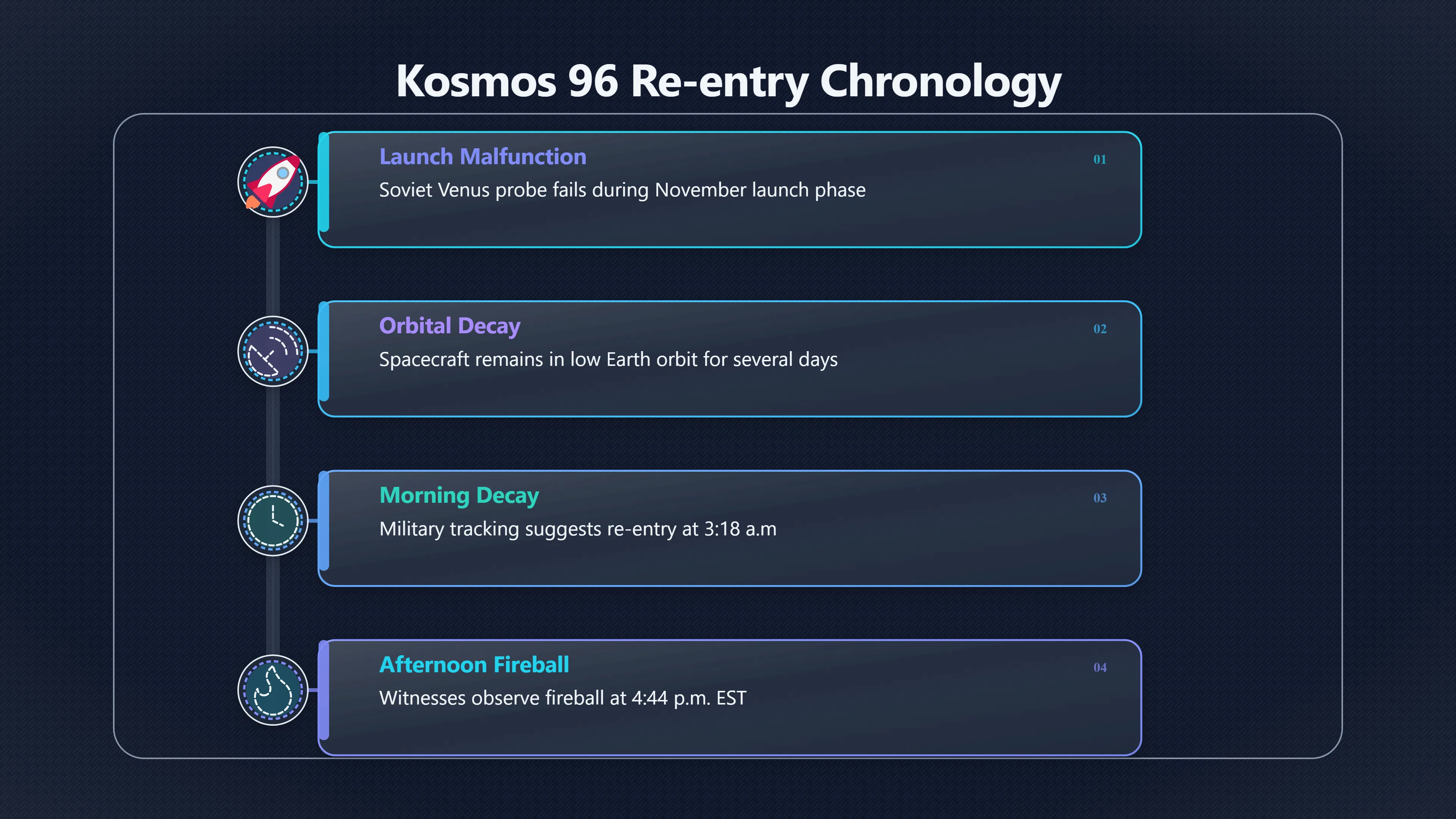
Kosmos 96 was a failed Soviet Venus probe left in low Earth orbit after a launch malfunction on 23 November 1965. Its orbit gradually decayed, and all sources agree that re-entry occurred on 9 December. The disagreement concerns the precise moment of atmospheric destruction.[Wikipedia]WikipediaKosmos 96Kosmos 96
Meanwhile, the fireball associated with the Kecksburg incident was widely observed across parts of the United States and Canada during the late afternoon. Contemporary astronomical reporting placed the event at approximately 4:44 p.m. EST. Aircraft reports, seismographic records and numerous eyewitness observations were tied to that same time window.[Wikipedia]WikipediaKecksburg UFO incidentMarch 7, 2026 — There is some speculation that the reentry of the Cosmos 96/Venera-type spacecraft was responsible for a fireball which w…
The resulting chronology looks roughly like this:
EventApproximate TimeKosmos 96 orbital decay according to later military-tracking interpretationsEarly morning, 9 December 1965Great Lakes–Pennsylvania fireballAbout 4:44–4:45 p.m. ESTReported Kecksburg ground incidentMinutes after the fireball
The gap between these events is the core issue. The larger the interval between the spacecraft’s decay and the observed fireball, the less plausible the identification becomes.
Morning Decay Data Versus Afternoon Fireball Reports
Supporters of the Kosmos 96 hypothesis often begin with a genuine coincidence: both events occurred on the same date. However, later examinations of tracking data introduced a major complication.
Research discussed in Leslie Kean’s investigation of the case cited United States Space Command data indicating that Kosmos 96 re-entered at approximately 3:18 a.m., more than thirteen hours before the late-afternoon fireball. The same review reported orbital reconstructions suggesting that any relevant pass over Pennsylvania would have occurred in the morning rather than during the period when witnesses saw the fireball.[Wikipedia]WikipediaKecksburg UFO incidentMarch 7, 2026 — There is some speculation that the reentry of the Cosmos 96/Venera-type spacecraft was responsible for a fireball which w…
Independent summaries of the controversy have reached similar conclusions. Discussions of the Kosmos 96 hypothesis note that Air Force tracking information placed the spacecraft’s orbital decay earlier than the approximately 21:43 UTC fireball observed over the Great Lakes region. Those analyses also point out that the observed atmospheric path appeared inconsistent with a typical satellite re-entry.[Wikipedia]WikipediaKosmos 96Kosmos 96
This distinction matters because orbital objects do not wander randomly across the sky. A spacecraft in a roughly 90-minute orbit follows a predictable ground track. If tracking data show the object had already decayed over another region hours earlier, it cannot simply reappear over Pennsylvania later in the day.
Why Orbital Timing Limits the Theory
The timing problem is not merely a disagreement over eyewitness memories. It arises from the constraints of orbital mechanics.
A low-Earth-orbit spacecraft such as Kosmos 96 travelled around the planet approximately every 90 minutes. Although precise decay predictions in the 1960s were imperfect, the possible location of the spacecraft at any given time was still limited by its orbital path. Once re-entry occurred, the object ceased to orbit. It could not generate another atmospheric passage many hours later.[Wikipedia]WikipediaKosmos 96Kosmos 96
This means that the Kosmos 96 theory must overcome two separate hurdles:
- The decay-time hurdle. The spacecraft must still have been in orbit at roughly 4:45 p.m. EST.
- The trajectory hurdle. Its final path would need to match the observed fireball track.
Both issues have proven difficult. Analyses of photographs and witness reports published after the event suggested a steep, meteor-like trajectory ending near western Lake Erie rather than the shallower geometry expected from orbital re-entry debris.[Wikipedia]WikipediaKecksburg UFO incidentMarch 7, 2026 — There is some speculation that the reentry of the Cosmos 96/Venera-type spacecraft was responsible for a fireball which w…
A spacecraft re-entering from orbit normally approaches on a path constrained by its previous orbit around Earth. A natural meteoroid can arrive on a much wider range of trajectories. Investigators who reconstructed the 1965 fireball therefore argued that its motion resembled a meteor more closely than a decaying spacecraft.[Wikipedia]WikipediaKecksburg UFO incidentMarch 7, 2026 — There is some speculation that the reentry of the Cosmos 96/Venera-type spacecraft was responsible for a fireball which w…
Could the Decay Time Be Wrong?
Advocates of the Kosmos 96 explanation sometimes note that re-entry predictions, especially in the 1960s, were not perfectly precise. Atmospheric drag, solar activity and limited tracking coverage could introduce uncertainty into decay estimates.
That observation is valid as a general principle. Re-entry predictions often carry margins of error, and historical tracking records are not always complete. However, the challenge for the Kosmos 96 theory is the scale of the discrepancy. A difference of minutes or even a few orbital revolutions might be accommodated within normal uncertainty. A difference of roughly half a day is much harder to reconcile with the available tracking reconstructions.[Wikipedia]WikipediaKecksburg UFO incidentMarch 7, 2026 — There is some speculation that the reentry of the Cosmos 96/Venera-type spacecraft was responsible for a fireball which w…
As a result, uncertainty alone does not eliminate the timing objection. To sustain the Kosmos 96 explanation, one must assume that the published decay estimates were substantially wrong and that the spacecraft remained in orbit far longer than later tracking analyses suggested.

What the Timing Evidence Means
Among the various criticisms of the Kosmos 96 hypothesis, the timing issue remains one of the strongest. The theory benefits from an undeniable coincidence—the Soviet probe and the Kecksburg fireball occurred on the same date—but coincidence is not enough. The key question is whether the spacecraft could physically have been over the Great Lakes and Pennsylvania at the moment witnesses reported the fireball.
The available orbital reconstructions and tracking-based assessments generally point in the opposite direction. They place Kosmos 96’s destruction earlier in the day and indicate that the observed fireball occurred after the spacecraft was no longer in orbit. If those reconstructions are correct, the famous Kecksburg event and the re-entry of Kosmos 96 were separate occurrences that happened on the same date rather than the same event observed from different perspectives.[Wikipedia]WikipediaKecksburg UFO incidentMarch 7, 2026 — There is some speculation that the reentry of the Cosmos 96/Venera-type spacecraft was responsible for a fireball which w…
Amazon book picks
Further Reading
Books and field guides related to Was Kosmos 96 Too Early for Kecksburg?. Use these as the next step if you want deeper reading beyond the article.
The UFO Evidence
Provides historical case documentation and competing interpretations useful for evaluating Kecksburg and Kosmos 96 timing claims.
UFOs and Government
Covers government investigations, records, tracking data and historical UFO controversies relevant to the Kecksburg debate.
Silent Invasion
Provides Pennsylvania UFO context from a leading local investigator closely tied to Kecksburg research.
Astonishing Encounters: Pennsylvania's Unknown Creatures, Cas...
Written by a principal Kecksburg investigator and expands the regional background surrounding unusual reports.
eBay marketplace picks
Marketplace Samples
Live-tested eBay searches with available results related to this page.


Endnotes
1.
Source: Wikipedia
Title: Kecksburg UFO incident
Link:https://en.wikipedia.org/wiki/Kecksburg_UFO_incident
Source snippet
March 7, 2026 — There is some speculation that the reentry of the Cosmos 96/Venera-type spacecraft was responsible for a fireball which w...
Published: March 7, 2026
2.
Source: Wikipedia
Title: Kosmos 96
Link:https://en.wikipedia.org/wiki/Kosmos_96
Additional References
3.
Source: enigmalabs.io
Link:https://enigmalabs.io/library/f45bb19d-5803-4ab6-a373-8799f64095c0
Source snippet
Kecksburg IncidentThe Kecksburg Incident involves a series of events that occurred on the night of December 9, 1965, involving the purpor...
Published: December 9, 1965
4.
Source: facebook.com
Link:https://www.facebook.com/PghGhostTour/posts/%F0%9D%90%93%F0%9D%90%A8%F0%9D%90%9D%F0%9D%90%9A%F0%9D%90%B2-%F0%9D%90%A2%F0%9D%90%AC-%F0%9D%90%AD%F0%9D%90%A1%F0%9D%90%9E-%F0%9D%9F%94%F0%9D%9F%8E%F0%9D%90%AD%F0%9D%90%A1-%F0%9D%90%80%F0%9D%90%A7%F0%9D%90%A7%F0%9D%90%A2%F0%9D%90%AF%F0%9D%90%9E%F0%9D%90%AB%F0%9D%90%AC%F0%9D%90%9A%F0%9D%90%AB%F0%9D%90%B2-%F0%9D%90%A8%F0%9D%90%9F-%F0%9D%90%96%F0%9D%90%9E%F0%9D%90%AC%F0%9D%90%AD%F0%9D%90%9E%F0%9D%90%AB%F0%9D%90%A7-%F0%9D%90%8F%F0%9D%90%9E%F0%9D%90%A7%F0%9D%90%A7%F0%9D%90%AC%F0%9D%90%B2%F0%9D%90%A5%F0%9D%90%AF%F0%9D%90%9A%F0%9D%90%A7%F0%9D%90%A2%F0%9D%90%9A%F0%9D%90%AC-%F0%9D%90%86%F0%9D%90%AB%F0%9D%90%9E%F0%9D%90%9A%F0%9D%90%AD-%F0%9D%90%94%F0%9D%90%85%F0%9D%90%8E-%F0%9D%90%94%F0%9D%90%80%F0%9D%90%8F-%F0%9D%90%84%F0%9D%90%AF%F0%9D%90%9E%F0%9D%90%A7%F0%9D%90%AD-%F0%9D%90%9A%F0%9D%90%AD-%F0%9D%90%8A%F0%9D%90%9E/1265688535592727/
Source snippet
December 9, 1965, at Kecksburg, Pennsylvania, United States, when a fireball was reported by citizens of...Read more...
Published: December 9, 1965
5.
Source: meteornews.net
Title: detailed analysis of the fireball 20160317031654 over united kingdom
Link:https://meteornews.net/news/detailed-analysis-of-the-fireball-20160317031654-over-united-kingdom/
Source snippet
Detailed analysis of the fireball 20160317_031654 over...2 Apr 2018 — This fireball belonging to the Northern March gamma Virginids (IAU...
6.
Source: facebook.com
Link:https://www.facebook.com/PABucketList/posts/the-kecksburg-space-acorn-refers-to-an-object-that-crashed-in-kecksburg-pennsylv/684934867520077/
Source snippet
9, 1965, they say, was a General Electric Mark 2 Re-entry Vehicle that had been launched by...Read more...
7.
Source: planet4589.org
Link:https://www.planet4589.org/space/
Source snippet
Jonathan's Space Home PageOn these pages, you can find extensive data on the history of space exploration. Statistical analyses Statistic...
8.
Source: catch.astro.umd.edu
Link:https://catch.astro.umd.edu/data?target=CK26B020
Source snippet
umd.edu[https://catch.astro.umd.edu/data?target=CK26B020No](https://catch.astro.umd.edu/data?target=CK26B020No) information is available for this page...
9.
Source: rcfp.org
Title: nasa ordered review its records data ufo sighting
Link:https://www.rcfp.org/nasa-ordered-review-its-records-data-ufo-sighting/
Source snippet
NASA Ordered to Review Its Records for Data on "UFO...10 Dec 2007 — A federal judge in October ordered NASA to conduct a thorough search...
10.
Source: discoveryuk.com
Title: [the kecksburg ufo incident]({{ ‘the-kecksburg-ufo-incident/’ | relative_url }}) a cold war mystery
Link:https://www.discoveryuk.com/mysteries/the-kecksburg-ufo-incident-a-cold-war-mystery/
Source snippet
The Kecksburg UFO Incident: A Cold War Mystery21 Aug 2024 — One popular theory suggests the object was the Soviet satellite Kosmos 96, be...
11.
Source: facebook.com
Link:https://www.facebook.com/MichellewRIGHTNOW/posts/here-is-the-story-i-did-on-the-60th-anniversary-of-the-kecksburg-ufo-we-still-ha/1399476958213112/
Source snippet
that occurred on December 9, 1965 at Kecksburg, PA.Read more...
Published: December 9, 1965
12.
Source: facebook.com
Title: What fell from the sky in Kecksburg PA
Link:https://www.facebook.com/MichellewRIGHTNOW/posts/here-is-a-little-preview-of-what-we-have-on-four-the-record-at-1100am-this-morni/1396547218506086/
Source snippet
December 9, 1965?...On Dec. 9, 1965, Kecksburg residents reported that a fireball streaked through the sky and then an object showed up...
Published: December 9, 1965
Topic Tree