Within Kecksburg
Why Fireballs Look Like Nearby Crashes
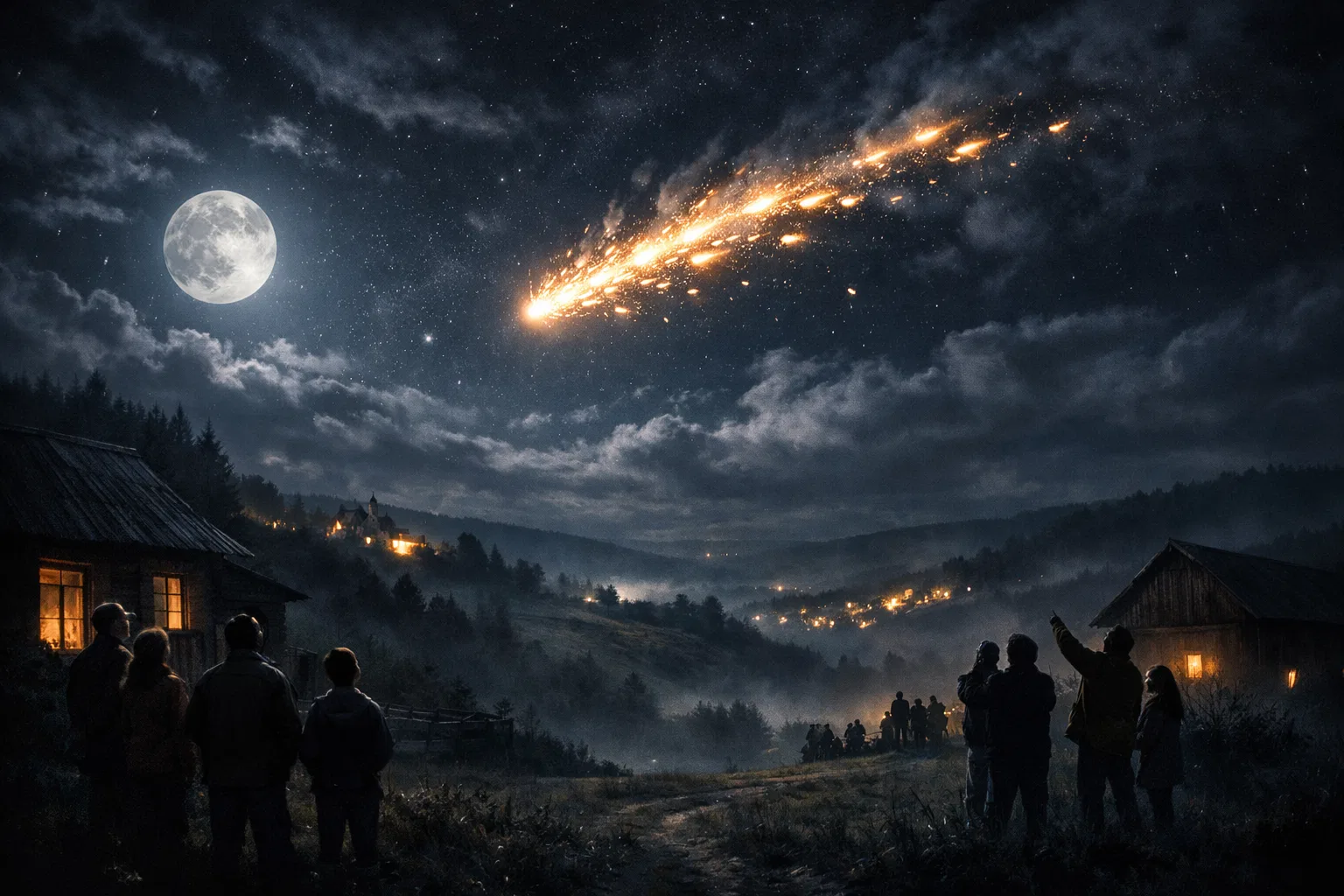
A high-altitude bolide can seem to crash nearby even when it travels far beyond the viewer's horizon.
On this page
- Altitude and perspective
- Fragmentation and sound
- Common witness misreadings
Page outline Jump by section
Introduction
A bright bolide can look like a nearby crash even when it is still tens of kilometres above the ground and travelling far beyond the observer’s horizon. That mechanism is central to understanding the Kecksburg UFO incident: the widely witnessed event of 9 December 1965 fits a classic pattern in which a real, dramatic fireball generated local impressions of descent, impact, sound, smoke, and search activity, while scientific reconstruction placed the main sky event over the Great Lakes region rather than simply over the woods near Kecksburg.[ADS Abs]adsabs.harvard.eduADS AbsThe Fireball of December 9, 1965-Part Iby VD Chamberlain · 1967 · Cited by 6 — December 9, 1965 a brilliant fireball was observed…
This does not by itself settle every claim made about Kecksburg. It does, however, explain why sincere witnesses in different towns can each feel that a fireball “came down over there”. Fireballs are high, fast, bright, noisy, and visually unfamiliar. Human depth perception is poor for isolated lights in the sky, and the final glowing phase of a meteor normally ends well above the ground; any surviving stones then enter a dark, invisible fall.[American Meteor Society]amsmeteors.orgAmerican Meteor Society Fireball FAQsAmerican Meteor SocietyFireball FAQs - American Meteor Society…
Altitude and Perspective
The most important fact about bolide sightings is that the visible object is usually not close to the ground. NASA’s general description of meteors places most meteors in the mesosphere, roughly 50–80 kilometres above Earth’s surface, while the American Meteor Society notes that a fireball usually needs to remain visibly luminous below about 20 kilometres to have a good chance of producing meteorites. A meteorite-dropping fireball is therefore already an unusually deep event; many brilliant fireballs never reach that stage at all.[National Geographic Education]education.nationalgeographic.orgNational Geographic EducationMeteor19 Oct 2023 — Meteors are often referred to as shooting stars or falling stars because of the bright t…
That height makes perspective treacherous. A fireball at 50 kilometres altitude can be visible over an enormous area, so observers separated by hundreds of kilometres may all report it as descending towards their own local horizon. To a person in Kecksburg, a steeply descending fireball could appear to pass beyond a ridge, treeline, or patch of woodland. To a person in Ohio or Ontario, the same object could seem to be dropping in a different direction. The apparent “nearby crash” is not necessarily deception or exaggeration; it is a natural result of watching a bright, distant object without reliable distance cues.
This is why the regional scale of the 1965 event matters. Contemporary and later summaries describe reports across multiple US states and Canada, with scientific discussion focusing on the Detroit-Windsor and Lake Erie region. The 1967 Journal of the Royal Astronomical Society of Canada analysis used trail photographs and a seismographic record to reconstruct the fireball’s path, rather than treating any single town’s impression as the true endpoint.[Wikipedia]WikipediaKecksburg UFO incidentKecksburg UFO incident
For Kecksburg, that creates a useful distinction: the sky event can be real and spectacular, while the perceived local impact can still be wrong. The witness statement “it looked as if it came down near us” is compatible with a bolide explanation. It becomes stronger evidence for a local crash only if supported by independent physical traces, a verified fall site, recovered fragments, or a documented chain of custody.
Fragmentation and Sound
Bolides are not quiet falling lamps. They ablate, flare, fragment, and sometimes explode in the atmosphere. NASA’s account of the Chelyabinsk superbolide explains the basic physics: as an object enters the atmosphere at high speed, a bow shock forms, the body heats and ablates, and fragmentation increases the area exposed to the air, intensifying braking and energy release. Disruption normally happens when pressure forces exceed the object’s strength, often near maximum brightness.[NASA Jet Propulsion Laboratory (JPL)]jpl.nasa.govNASA Jet Propulsion Laboratory (JPL)Additional Details on the Large Feb. 15 Fireball over Russia | NASA Jet Propulsion Laboratory (JPL)…
That behaviour helps explain why witnesses often describe a fireball as “breaking up”, “exploding”, “dropping pieces”, or “ending in a flash”. A flare can feel like the moment of impact, even though it may occur high above the ground. Chelyabinsk is a modern, well-instrumented example: NASA describes a roughly 17–20 metre object that fragmented at high altitude, reached maximum brightness at about 23.3 kilometres, and produced meteorites as well as a powerful shock wave.[NASA Jet Propulsion Laboratory (JPL)]jpl.nasa.govNASA Jet Propulsion Laboratory (JPL)Additional Details on the Large Feb. 15 Fireball over Russia | NASA Jet Propulsion Laboratory (JPL)…
Sound adds another trap. The American Meteor Society explains that sonic booms from very bright bolides may be heard if the object penetrates deeply enough, but because sound travels far more slowly than light, the boom usually arrives about 1.5 to 4 minutes after the visible explosion. Observers are advised to listen for up to five minutes after the fireball.[American Meteor Society]amsmeteors.orgAmerican Meteor Society Fireball FAQsAmerican Meteor SocietyFireball FAQs - American Meteor Society…
That delay can scramble memory. A person sees the fireball vanish, then hears a boom, feels vibration, or sees animals react. The natural inference is that something has just struck nearby. In reality, the sound may have travelled from a high-altitude fragmentation point many kilometres away. In a wooded rural setting such as Kecksburg, with hills, darkness, and excitement, a delayed boom could easily be folded into a crash narrative.
Why the Last Visible Point Is Not the Landing Point
One of the most persistent false impressions is that a fireball remains visible until it hits the ground. The American Meteor Society is explicit that this is not how meteorite falls normally work. At roughly 15–20 kilometres altitude, surviving fragments usually slow enough that ablation stops and visible light is no longer generated. The remaining pieces continue in “dark flight”, falling invisibly at terminal velocity.[American Meteor Society]amsmeteors.orgAmerican Meteor Society Fireball FAQsAmerican Meteor SocietyFireball FAQs - American Meteor Society…
This matters directly for Kecksburg-style claims. A witness can honestly point to the place where the glowing object disappeared and say, “it landed there”, but the luminous phase and the physical fall are not the same thing. If meteorites survived, winds and momentum could carry fragments away from the last bright point. If the object fully disintegrated, there may be no recoverable mass at all.
Modern fireball science treats trajectory reconstruction as a technical problem, not as a simple extension of eyewitness lines of sight. Fireball networks use multiple observing stations to triangulate and dynamically analyse meteoroids; researchers note that the accuracy of trajectory methods directly affects both orbit calculation and any possible meteorite recovery area. This is precisely the kind of information that casual witnesses in 1965 did not have.[arXiv]arxiv.orgOpen source on arxiv.org.
The lesson is not that witnesses are useless. It is that unaided witness geography is fragile. Reports of direction, brightness, duration, sound, and fragmentation can be valuable, but the claimed fall point needs stronger support. In Kecksburg, the bolide mechanism explains how a broad regional fireball could seed a localised crash belief without requiring the object itself to have landed in the specific woodland later made famous.

Common Witness Misreadings
Several recurring misreadings turn bolides into apparent crash events. They are especially relevant to Kecksburg because the local story combines a brilliant sky object with reports of a thump, smoke, searchers, and a secured area.
“It passed behind the trees, so it landed in the woods.” A high fireball can set below a local horizon just like the Sun or Moon. The treeline marks the observer’s blocked view, not the object’s distance.
“It got brighter at the end, so that was impact.” A terminal flare is often fragmentation or rapid ablation high in the atmosphere. The brightest moment can occur kilometres above the ground.
“The boom proves it hit nearby.” A sonic boom can arrive minutes after the visual event and may be generated by high-altitude fragmentation rather than ground impact.[American Meteor Society]amsmeteors.orgAmerican Meteor Society Fireball FAQsAmerican Meteor SocietyFireball FAQs - American Meteor Society…
“Falling pieces mean wreckage must be nearby.” Fragmentation can produce dust, tiny debris, or meteorites spread over a broad strewn field. Many very bright meteors produce no recoverable meteorites, especially if the body is fragile or comet-like.[American Meteor Society]amsmeteors.orgAmerican Meteor Society Fireball FAQsAmerican Meteor SocietyFireball FAQs - American Meteor Society…
“A real search means a real object was found.” Searches often follow alarming reports even when no object is recovered. In the Kecksburg case, the tension between reports of an official search and later statements that nothing was found is one reason the story endured; it is not, by itself, proof of a landed craft.[Wikipedia]WikipediaKecksburg UFO incidentKecksburg UFO incident
What Bolide Behaviour Explains at Kecksburg
The bolide model explains the strongest and least controversial layer of the Kecksburg incident: a brilliant object was seen over a wide region, it was bright enough to alarm witnesses, and it was interpreted by astronomers and officials as a meteor-like fireball. The 1965 reports were not simply a local rumour beginning in one village; they were part of a large regional sky event.[Wikipedia]WikipediaKecksburg UFO incidentKecksburg UFO incident
It also explains why local certainty could form quickly. A person who sees a fireball descend behind a ridge, hears a delayed boom, and then learns that police or military personnel are searching nearby has a coherent story available: something came down here. That story may be psychologically compelling even when the physical mechanism points elsewhere.
What the bolide model does not explain on its own are the later, more specific claims of an acorn-shaped metallic object, strange markings, and removal on a lorry. Those claims require separate evidence. They cannot be dismissed merely because bolides cause false impact impressions, but neither should they be treated as confirmed simply because a real fireball occurred. The mechanism narrows the question: the burden shifts from “was there a dramatic object in the sky?” to “is there reliable evidence that a physical object landed and was recovered near Kecksburg?”

Why This Mechanism Still Matters
Bolide behaviour is not a minor footnote to the Kecksburg UFO incident. It is the bridge between a documented astronomical event and a contested crash-recovery legend. Without understanding altitude, perspective, fragmentation, delayed sound, and dark flight, the case can look simpler than it is: either witnesses saw a crash, or they invented one. The more realistic reading is that a genuine fireball created conditions in which a nearby crash seemed obvious to people on the ground.
That is why Kecksburg remains a useful case study in false impact impressions. It shows how an event can be both real and mislocated, both dramatic and natural, both sincerely reported and incorrectly interpreted. The bolide explanation does not remove every mystery from the wider Kecksburg story, but it strongly accounts for the specific mechanism by which a high-altitude fireball could become remembered as something that crashed just beyond the trees.
Amazon book picks
Further Reading
Books and field guides related to Why Fireballs Look Like Nearby Crashes. Use these as the next step if you want deeper reading beyond the article.
Field Guide to Meteors and Meteorites
Covers meteor appearances, trajectories and common misconceptions.
Meteorites
Explains fireballs, meteorite falls, fragmentation and atmospheric behaviour.
The Demon-Haunted World
Rating: 4.5/5 from 43 Google Books ratings
Useful for understanding witness perception and extraordinary claims.
eBay marketplace picks
Marketplace Samples
Example marketplace items related to this page. Use the search link to explore similar finds on eBay.


Endnotes
1.
Source: Wikipedia
Title: Kecksburg UFO incident
Link:https://en.wikipedia.org/wiki/Kecksburg_UFO_incident
2.
Source: jpl.nasa.gov
Link:https://www.jpl.nasa.gov/news/additional-details-on-the-large-feb-15-fireball-over-russia/
Source snippet
NASA Jet Propulsion Laboratory (JPL)Additional Details on the Large Feb. 15 Fireball over Russia | NASA Jet Propulsion Laboratory (JPL)...
3.
Source: science.nasa.gov
Title: Science Meteors and Meteorites: Facts
Link:https://science.nasa.gov/solar-system/meteors-meteorites/facts/
4.
Source: arxiv.org
Link:https://arxiv.org/abs/1911.00816
5.
Source: ares.jsc.nasa.gov
Link:https://ares.jsc.nasa.gov/meteorite-falls/events/
6.
Source: arxiv.org
Link:https://arxiv.org/pdf/2602.15440
7.
Source: Wikipedia
Title: [Kosmos]({{ ‘kosmos-96/’ | relative_url }}) 96
Link:https://en.wikipedia.org/wiki/Kosmos_96
8.
Source: Wikipedia
Title: List of reported UFO sightings
Link:https://en.wikipedia.org/wiki/List_of_reported_UFO_sightings
9.
Source: Wikipedia
Title: Chelyabinsk meteor
Link:https://en.wikipedia.org/wiki/Chelyabinsk_meteor
10.
Source: youtube.com
Title: The SKY Is Getting LOUDER — The 3.9 Sigma Fireball and Sonic Boom Anomaly
Link:https://www.youtube.com/watch?v=wqLl2fgf3q8
Source snippet
FIREBALLS - Something Changed NEAR EARTH - What They Don't EXPLAIN...
11.
Source: youtube.com
Link:https://www.youtube.com/watch?v=sW9uNOBJfiw
Source snippet
The Mysterious 1965 UFO Crash | Beyond Skinwalker Ranch (S3) | History...
12.
Source: adsabs.harvard.edu
Link:https://adsabs.harvard.edu/full/1967JRASC..61..184C
Source snippet
ADS AbsThe Fireball of December 9, 1965-Part Iby VD Chamberlain · 1967 · Cited by 6 — December 9, 1965 a brilliant fireball was observed...
Published: December 9, 1965
13.
Source: amsmeteors.org
Title: American Meteor Society Fireball FAQs
Link:https://www.amsmeteors.org/fireballs/faqf/
Source snippet
American Meteor SocietyFireball FAQs - American Meteor Society...
14.
Source: education.nationalgeographic.org
Link:https://education.nationalgeographic.org/resource/meteor/
Source snippet
National Geographic EducationMeteor19 Oct 2023 — Meteors are often referred to as shooting stars or falling stars because of the bright t...
15.
Source: amsmeteors.org
Link:https://www.amsmeteors.org/videos?video_id=22128
16.
Source: fireball.amsmeteors.org
Title: browse reports
Link:https://fireball.amsmeteors.org/members/imo_view/browse_reports
17.
Source: amsmeteors.org
Title: ams q1 2026 fireball analysis
Link:https://amsmeteors.org/ams-q1-2026-fireball-analysis.html
18.
Source: facebook.com
Link:https://www.facebook.com/danskoff/posts/new-update-american-meteor-society-has-a-report-on-thisfireball-meteor-did-you-h/2630929023584303/
19.
Source: youtube.com
Link:https://www.youtube.com/watch?v=TuZ-TP0UN30
20.
Source: icq.eps.harvard.edu
Link:https://www.icq.eps.harvard.edu/meteorites.html
21.
Source: adsabs.harvard.edu
Link:https://adsabs.harvard.edu/full/1994JRASC..88..332H
22.
Source: ui.adsabs.harvard.edu
Link:https://ui.adsabs.harvard.edu/abs/2014me13.conf….3P/abstract
23.
Source: unsolvedmysteries.fandom.com
Title: Kecksburg UFO
Link:https://unsolvedmysteries.fandom.com/wiki/Kecksburg_UFO
24.
Source: scistarter.org
Title: American Meteor Society
Link:https://scistarter.org/american-meteor-society-meteor-observing
25.
Source: abcnews.com
Link:https://abcnews.com/Technology/story?id=3785376&page=1
Additional References
26.
Source: youtube.com
Title: The Kecksburg UFO Mystery: Secrets, Witnesses and Vanished Evidence
Link:https://www.youtube.com/watch?v=vkZszbMzl3Q
Source snippet
The SKY Is Getting LOUDER provides critical scientific background on how modern data from organizations like the American Meteor Society...
27.
Source: youtube.com
Link:https://www.youtube.com/watch?v=Ac3hYt3k-Eo
Source snippet
The Kecksburg Incident: What Really Happened Here?...
28.
Source: youtube.com
Title: The Kecksburg Incident: What Really Happened Here?
Link:https://www.youtube.com/watch?v=BXh2zTD9Kug
Source snippet
The Kecksburg UFO Mystery: Secrets, Witnesses and Vanished Evidence...
29.
Source: researchgate.net
Link:https://www.researchgate.net/publication/375897896_The_Golden_meteorite_fall_Fireball_trajectory_orbit_and_meteorite_characterization
30.
Source: facebook.com
Link:https://www.facebook.com/wilphotographer/posts/a-fireball-was-seen-and-caught-on-camera-early-hours-of-this-morning-with-witnes/1489144646164035/
31.
Source: facebook.com
Link:https://www.facebook.com/cnn/posts/a-rare-fireball-bright-enough-to-be-seen-during-broad-daylight-dazzled-skies-and/1310785570914091/
32.
Source: instagram.com
Link:https://www.instagram.com/reel/DSB4fRqAvMw/
33.
Source: facebook.com
Link:https://www.facebook.com/MeteorologistRossEllet/posts/did-you-see-it-it-happened-again-another-fireball-meteor-lit-up-the-sky-last-nig/1508699200614732/
34.
Source: journalrecord.com
Link:https://journalrecord.com/2026/06/16/experts-puzzled-surge-fireball-meteors-north-america/
35.
Source: instagram.com
Link:https://www.instagram.com/reel/DWUfqAtkS_v/?hl=en
Topic Tree