Within Re entry
Why Would Officials Hide a Re entry Body?
A misdirected classified re-entry object would give officials a reason for speed, silence, and restricted access without invoking aliens.
On this page
- Cold War secrecy around re entry technology
- Sensitive hardware and intelligence value
- What secrecy can and cannot prove
Page outline Jump by section
Introduction
Within the classified re-entry vehicle theory of the Kecksburg incident, secrecy is not an added mystery but the central mechanism. If the object was a misplaced American re-entry body, test vehicle, or intelligence-related payload, a rapid military response would have been the expected Cold War reaction rather than evidence of something extraterrestrial. The theory relies on ordinary security practices: recover sensitive hardware, restrict access, control information, and prevent technical details from becoming public. In that framework, the key question is not whether officials could have kept a recovery quiet, but whether they would have had strong reasons to do so.
Cold War Secrecy Around Re-entry Technology
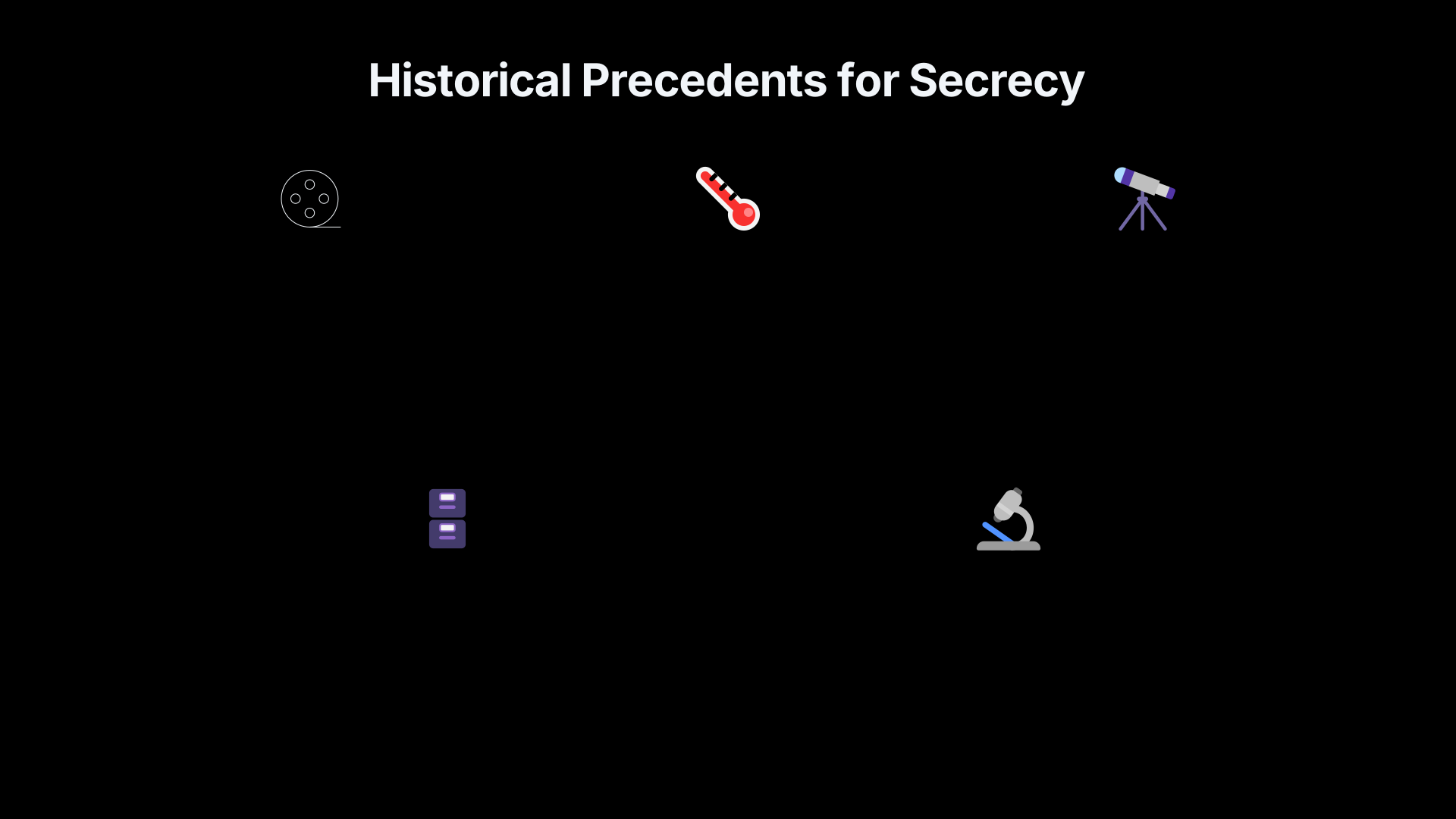
By the mid-1960s, re-entry vehicles sat at the intersection of several of the United States’ most sensitive programmes: nuclear missile delivery systems, reconnaissance satellites, and advanced aerospace research. Many of these projects remained classified for decades. Even the existence of major organisations such as the National Reconnaissance Office was itself secret during the period.[Mitchell Institute for Aerospace Studies]mitchellaerospacepower.orgMitchell Institute for Aerospace StudiesAir Force UAVs The Secret HistoryJuly 2, 2010 — by TP Ehrhard · 2010 · Cited by 200 — Starting in…
The General Electric Mark 2 re-entry vehicle often mentioned in Kecksburg discussions was a real military system used on Thor and Atlas missile programmes. Its shape, heat-shield design, and operational role were directly connected to strategic nuclear delivery technology. Some performance details remained classified long after the system entered service. National Air and Space Museum+2Air Force Historical Foundation[airandspace.si.edu]airandspace.si.eduNational Air and Space MuseumMissile, Reentry Vehicle, Mark 2This is an unflown Mark 2 reentry vehicle (RV) that carried the nuclear warh…
In that environment, an unexpected landing of a re-entry body would have triggered several standard security concerns:
- Prevent public examination of military hardware.
- Protect information about heat-shield materials and re-entry engineering.
- Avoid revealing design features linked to missile accuracy or warhead delivery.
- Maintain secrecy around associated intelligence or reconnaissance programmes.
These concerns did not require the object to be revolutionary. During the Cold War, even apparently mundane technical details could have intelligence value.
Recovery and Secrecy Were Already Normal Practice
The classified re-entry theory gains plausibility from the fact that recovery operations were common in American space and intelligence programmes. The Air Force routinely tracked and recovered reconnaissance capsules carrying exposed film from space missions. Those recoveries were treated as high-priority national-security operations and remained secret for decades. National Museum of the U.S. Air Force[nationalmuseum.af.mil]nationalmuseum.af.milNational Museum of the U.SAir ForceCold War in Space: Top Secret Reconnaissance Satellites…The USAF began working on satellites as early as 1956, and tracked an…
Likewise, experimental re-entry vehicles frequently carried instrumentation intended to be examined after flight. Recovery was often part of the programme itself because engineers needed the hardware to study heating, structural performance, and materials behaviour after atmospheric return. AIAA - Shaping the future of aerospace+2Chutes.nl[aiaa.org]aiaa.orgShaping the future of aerospace Historic Aerospace SiteThe subsequent award to. GE was based on GE's very important work on Project HERMES, dating to. 1944, and on the…Read more…
Viewed through that lens, witness reports of officials securing an area would not necessarily indicate an extraordinary object. They could be consistent with established procedures surrounding sensitive aerospace hardware.
Sensitive Hardware and Intelligence Value
A common misunderstanding is that secrecy would only make sense if the object contained a weapon. In reality, Cold War intelligence agencies valued technical hardware of almost any kind.
Recovered equipment could reveal manufacturing techniques, thermal protection methods, guidance technologies, telemetry systems, or reconnaissance capabilities. Government records show that American intelligence agencies actively sought foreign missiles, rockets, spacecraft components, and re-entry hardware for technical exploitation. Even fragments were considered worth collecting and analysing.[National Security Archive]nsarchive.gwu.eduNational Security Archive The U.SGovernment's Secret Search for Foreign Objects…31 Jan 2018 — The CIA and DoD obtained the material through various means. U.S. and all…
The same logic would apply in reverse. If an American vehicle came down in an accessible area, officials would have had incentives to minimise public handling of it. The concern would not necessarily be immediate danger; it would be preventing uncontrolled examination, photography, or eventual transfer of information to foreign intelligence services.
For supporters of the classified re-entry explanation, this provides a straightforward motive:

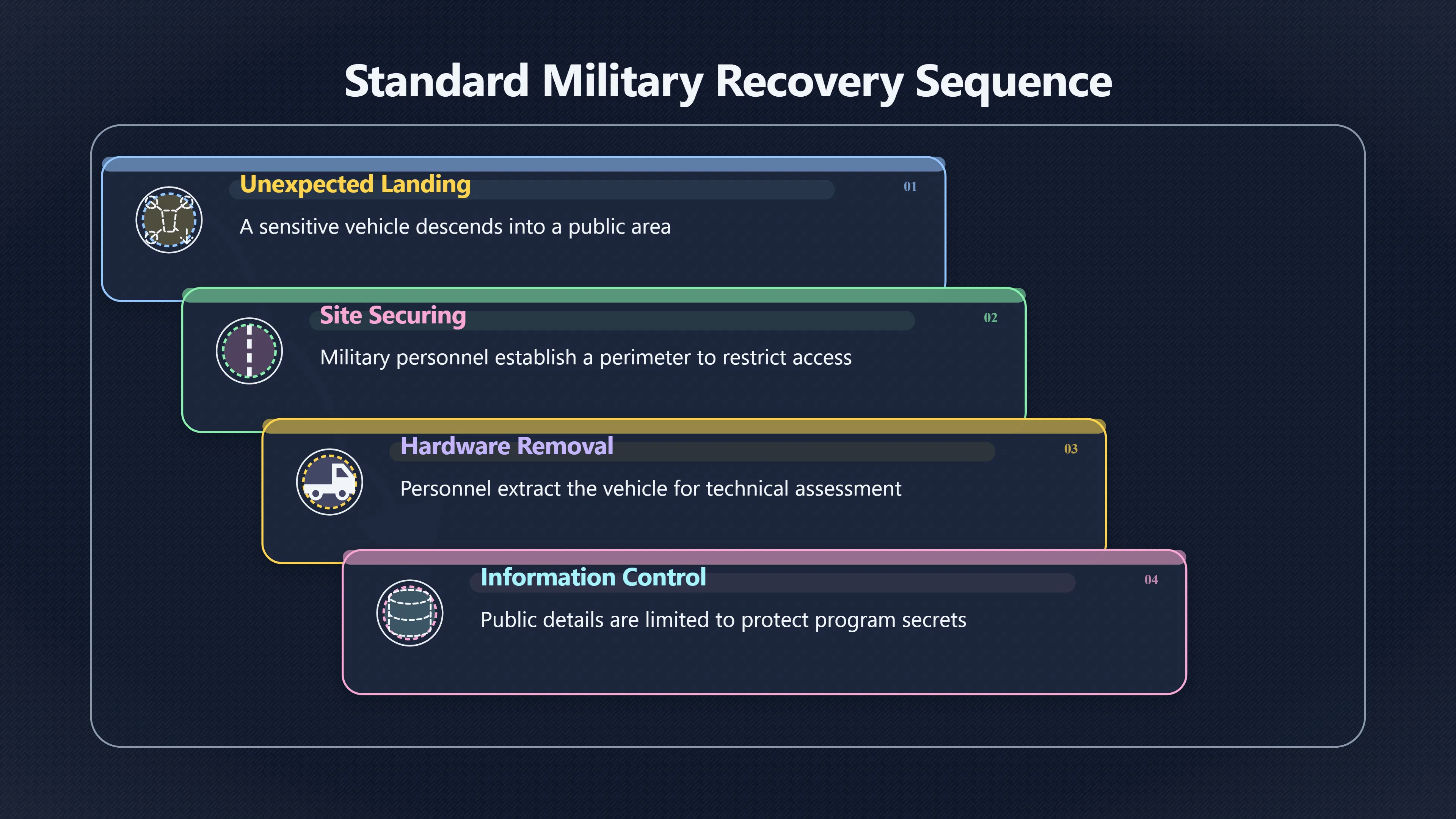
- A sensitive vehicle lands unexpectedly.
- Military personnel secure the location.
- The hardware is removed for technical assessment.
- Public information is limited to avoid revealing programme details.
Nothing in that sequence requires an alien craft. It reflects standard security behaviour surrounding military and intelligence technology.
Why Silence Could Outlast the Incident
One reason the theory remains attractive is that Cold War secrecy often survived long after the original technology became obsolete.
Many reconnaissance and aerospace programmes were hidden for decades. The Corona reconnaissance satellite programme, for example, remained classified until the 1990s despite having ended years earlier. Details of numerous missile, satellite, and re-entry projects emerged only gradually through declassification. National Museum of the U.S. Air Force+2Wikipedia[nationalmuseum.af.mil]nationalmuseum.af.milNational Museum of the U.SAir ForceCold War in Space: Top Secret Reconnaissance Satellites…The USAF began working on satellites as early as 1956, and tracked an…
That historical pattern creates a plausible explanation for why officials might never have publicly clarified a recovery if one occurred. The original decision-makers may have regarded disclosure as unnecessary, while records could have remained scattered, classified, lost, or embedded within larger secret programmes.
Importantly, this argument does not require a coordinated conspiracy spanning generations. Bureaucratic inertia, compartmentalised records, and routine classification can produce long-running mysteries without deliberate deception.
What Secrecy Can and Cannot Prove
The strongest aspect of the classified re-entry vehicle theory is that it explains why authorities might have acted quickly and restricted access. Cold War institutions repeatedly demonstrated a willingness to recover sensitive hardware discreetly and to withhold information about aerospace programmes. National Museum of the U.S. Air Force+2Wikipedia[nationalmuseum.af.mil]nationalmuseum.af.milNational Museum of the U.SAir ForceCold War in Space: Top Secret Reconnaissance Satellites…The USAF began working on satellites as early as 1956, and tracked an…
However, secrecy alone cannot identify what was recovered.
A restricted area, military presence, or missing documentation does not automatically point to a Mark 2 re-entry vehicle, a reconnaissance payload, or any other specific object. Nor does it prove that a recovery occurred at all. The same observations that support a classified-hardware interpretation can also be interpreted more cautiously as rumours, misremembered events, or routine responses to reports of a possible crash.
This is the central limitation of the secrecy argument. It offers a credible motive for concealment, but it does not supply the missing evidence needed to demonstrate exactly what came down near Kecksburg. The theory’s value lies in explaining why officials might have behaved as witnesses described, not in proving the identity of the object itself.
Amazon book picks
Further Reading
Books and field guides related to Why Would Officials Hide a Re-entry Body?. Use these as the next step if you want deeper reading beyond the article.
Area 51
Explains why sensitive aerospace and defense programs were concealed and how secrecy operated during the Cold War.
UFO
Covers government investigations, secrecy, military responses, and competing explanations for famous UFO cases.
Skunk Works
Provides real-world context for classified aerospace development, technology protection, and government secrecy.
The Kecksburg UFO Incident
Focused specifically on the Kecksburg event and the competing explanations surrounding it.
eBay marketplace picks
Marketplace Samples
Example marketplace items related to this page. Use the search link to explore similar finds on eBay.


Endnotes
1.
Source: nationalmuseum.af.mil
Title: National Museum of the U.S
Link:https://www.nationalmuseum.af.mil/Visit/Museum-Exhibits/Fact-Sheets/Display/Article/195923/cold-war-in-space-top-secret-reconnaissance-satellites-revealed/
Source snippet
Air ForceCold War in Space: Top Secret Reconnaissance Satellites...The USAF began working on satellites as early as 1956, and tracked an...
2.
Source: Wikipedia
Title: 6593d Test Squadron
Link:https://en.wikipedia.org/wiki/6593d_Test_Squadron
3.
Source: aiaa.org
Title: Shaping the future of aerospace Historic Aerospace Site
Link:https://aiaa.org/wp-content/uploads/2026/03/GE-ReEntry-Systems-Historic-Aerospace-Site-AIAAHistory-TC.pdf
Source snippet
The subsequent award to. GE was based on GE's very important work on Project HERMES, dating to. 1944, and on the...Read more...
4.
Source: chutes.nl
Link:https://chutes.nl/missions/testmissions/entry_test/re-entry-technology-demonstrators.html
5.
Source: Wikipedia
Title: ASSET (spacecraft)
Link:https://en.wikipedia.org/wiki/ASSET_%28spacecraft%29
6.
Source: Wikipedia
Title: Kecksburg UFO incident
Link:https://en.wikipedia.org/wiki/Kecksburg_UFO_incident
Source snippet
Kecksburg UFO incidentThe Kecksburg UFO incident occurred on December 9, 1965, at Kecksburg, Pennsylvania, United States, when a fireb...
Published: December 9, 1965
7.
Source: mitchellaerospacepower.org
Link:https://www.mitchellaerospacepower.org/app/uploads/2022/08/MS_UAV_0710.pdf
Source snippet
Mitchell Institute for Aerospace StudiesAir Force UAVs The Secret HistoryJuly 2, 2010 — by TP Ehrhard · 2010 · Cited by 200 — Starting in...
Published: July 2, 2010
8.
Source: airandspace.si.edu
Link:https://airandspace.si.edu/collection-objects/missile-reentry-vehicle-mark-2/nasm_A19751430000
Source snippet
National Air and Space MuseumMissile, Reentry Vehicle, Mark 2This is an unflown Mark 2 reentry vehicle (RV) that carried the nuclear warh...
9.
Source: afhistory.org
Link:https://www.afhistory.org/airpowerhistory/Air_Power_History_2017_fall.pdf
10.
Source: nsarchive.gwu.edu
Title: National Security Archive The U.S
Link:https://nsarchive.gwu.edu/briefing-book/intelligence/2018-01-31/scavenging-intelligence-us-governments-secret-search-foreign-objects-during-cold-war
Source snippet
Government's Secret Search for Foreign Objects...31 Jan 2018 — The CIA and DoD obtained the material through various means. U.S. and all...
11.
Source: nsarchive.gwu.edu
Title: National Security Archive Possible Recovery of Soviet Reentry Vehicles
Link:https://nsarchive.gwu.edu/document/16268-document-16-possible-recovery-soviet-reentry
Source snippet
Memorandum...31 Jan 2018 — The United States was also developing a deep-sea vehicle under Project SAND DOLLAR to locate and recover the...
12.
Source: primarysources.brillonline.com
Title: cold war intelligence
Link:https://primarysources.brillonline.com/browse/cold-war-intelligence
Source snippet
War IntelligenceThis collection of 2,360 formerly classified U.S. government documents (most of them classified Top Secret or higher) pro...
13.
Source: nationalmuseum.af.mil
Link:https://www.nationalmuseum.af.mil/Visit/Museum-Exhibits/Fact-Sheets/Display/Article/197973/peacekeeper-re-entry-vehicles-deployment-bus/
Source snippet
The deployment module, or "bus," carried...Read more...
Additional References
14.
Source: nasa.gov
Link:https://www.nasa.gov/wp-content/uploads/2015/04/695726main_cominghome-ebook.pdf
Source snippet
Reentry and Recovery From SpaceTo help with the Avcoat research, NASA came to the Smithsonian Institution's. National Air and Space Museu...
15.
Source: ccspacemuseum.org
Link:https://ccspacemuseum.org/artifacts/heatsink-nose-cone/
Source snippet
Heatsink Nose ConeThe Heatsink, Mark 2, was built by General Electric Re-entry Systems. The Mark 2 blunt body was designed to deflect hea...
16.
Source: waru.edu
Link:https://www.waru.edu/sites/default/files/Migrated/CopDocuments/History%20of%20Acquisition%20in%20the%20DoD%20Volume%20I%20Rearming%20for%20the%20Cold%20War%201945%201960%20Elliott%20V.%20Converse%20III.pdf
Source snippet
REARMING FOR THE COLD WAR 1945-196012 Jan 2026 — technologies led to remarkable advances in aircraft, missiles, ships, satellites, land v...
17.
Source: positivelypittsburgh.com
Link:https://positivelypittsburgh.com/[the-kecksburg-ufo-incident
18.
Source: history.defense.gov
Title: OSDHO Acquisition Series Vol1
Link:https://history.defense.gov/Portals/70/Documents/acquisition_pub/OSDHO-Acquisition-Series-Vol1.pdf?ver=rGUpVbIx85BVDq6g4–cyA%3D%3D
Source snippet
FOR THE COLD WAR 1945-1960technologies led to remarkable advances in aircraft, missiles, ships, satellites, land vehicles, electronic equ...
19.
Source: reddit.com
Link:https://www.reddit.com/r/todayilearned/comments/6fll4h/today_i_learned_of_the_kecksburg_pa_ufo_incident/
Source snippet
uclear tipper General Electric Mark 2 re-entry vehicle. r...Read more...
20.
Source: encyclopedia.pub
Link:https://encyclopedia.pub/entry/37190
Source snippet
ion system (TPS) based upon a metallic heat shield (the...Read more...
21.
Source: facebook.com
Link:https://www.facebook.com/NorwinPublicLibrary/posts/7215ee9c/1367106712128508/
Source snippet
Kecksburg: A Cold War UFO Cover-Up? - The Gralien Report.Read more...
22.
Source: journals.openedition.org
Link:https://journals.openedition.org/ejas/20427?lang=en
Source snippet
War in Space: Reconnaissance Satellites and US-...This article traces the history of US and Soviet reconnaissance satellites during the...
23.
Source: youtube.com
Link:https://www.youtube.com/watch?v=vkZszbMzl3Q
Source snippet
December 9, 1965, something mysterious fell from the sky near the small town of Kecksburg, Pennsylvania. Witnesses reported a glowing...
Published: December 9, 1965
Topic Tree