Within Cold War
What Moon Dust Reveals About Fallen Debris
Project Moon Dust shows why Cold War officials treated fallen space hardware as intelligence material, not just curiosity.
On this page
- What Project Moon Dust was meant to recover
- How diplomats and defence channels handled fragments
- Why the records matter for Kecksburg claims
Page outline Jump by section
Introduction
Project Moon Dust is one of the strongest documented examples of how the United States treated fallen space hardware as an intelligence and diplomatic matter during the Cold War. Rather than focusing on unidentified flying objects, the programme concentrated on locating, securing, identifying and, when possible, recovering fragments of spacecraft and rocket hardware that had fallen back to Earth. Declassified records show that officials regarded such debris as technically valuable, legally sensitive and potentially important for understanding foreign space capabilities. Those records matter in discussions of the Kecksburg incident because they demonstrate that rapid government interest in an unidentified fallen object was not unusual in itself. The existence of recovery programmes does not prove what happened at Kecksburg, but it establishes that the recovery of unexplained aerospace debris was a real and organised government activity.[Government Attic]Recovery programmes were real.Open source on governmentattic.org.
What Project Moon Dust Was Meant to Recover
Project Moon Dust emerged during the early space age, when both superpowers were launching satellites, probes and military-related space systems at an accelerating pace. The programme’s purpose was to locate and recover space objects or fragments that survived atmospheric re-entry, especially when they might reveal information about foreign technology. Contemporary descriptions link the project to efforts to exploit Soviet hardware that unexpectedly became available outside Soviet control.[Wikipedia]wikipedia.orgProject Moon DustProject Moon Dust
The programme’s significance becomes clearer when viewed through the realities of the 1960s. A recovered fragment could potentially reveal:
- Manufacturing techniques and metallurgy.
- Heat-shield construction and re-entry engineering.
- Propulsion-system components.
- Identification markings linking debris to a specific launch.
- Evidence about the capabilities of foreign space programmes.
In other words, a recovered object was not merely scrap metal. It could function as an intelligence source. This explains why military and diplomatic channels sometimes reacted quickly when reports of unusual debris appeared.[Wikipedia]wikipedia.orgProject Moon DustProject Moon Dust
The declassified State Department collection covering 1967–1972 shows officials discussing reports of recovered objects in multiple countries, exchanging descriptions, photographs and assessments while attempting to determine origin and ownership. The records reveal a systematic process rather than isolated curiosity.[Government Attic]Recovery programmes were real.Open source on governmentattic.org.
How Diplomats and Defence Channels Handled Fragments
One of the most revealing aspects of the Moon Dust records is the extent to which diplomacy became intertwined with technical recovery.
Determining Ownership
Space law was still developing during the late 1960s. The 1967 Outer Space Treaty established that launching states retained rights and responsibilities connected to their space objects even after re-entry. As a result, recovered debris could trigger international discussions over custody, examination and return.[UNOOSA]unoosa.orgThe Outer Space TreatyTreaty on Principles Governing the Activities of States in the Exploration and Use of Outer Space, including…
The Moon Dust files contain exchanges in which officials sought to identify whether fragments were Soviet, American or of uncertain origin. In some cases, governments provided descriptions to Soviet representatives and invited them to determine whether the material belonged to the USSR. Questions of ownership were therefore not merely technical; they carried diplomatic implications.[Government Attic]Recovery programmes were real.Open source on governmentattic.org.
Recovery Before Public Attention
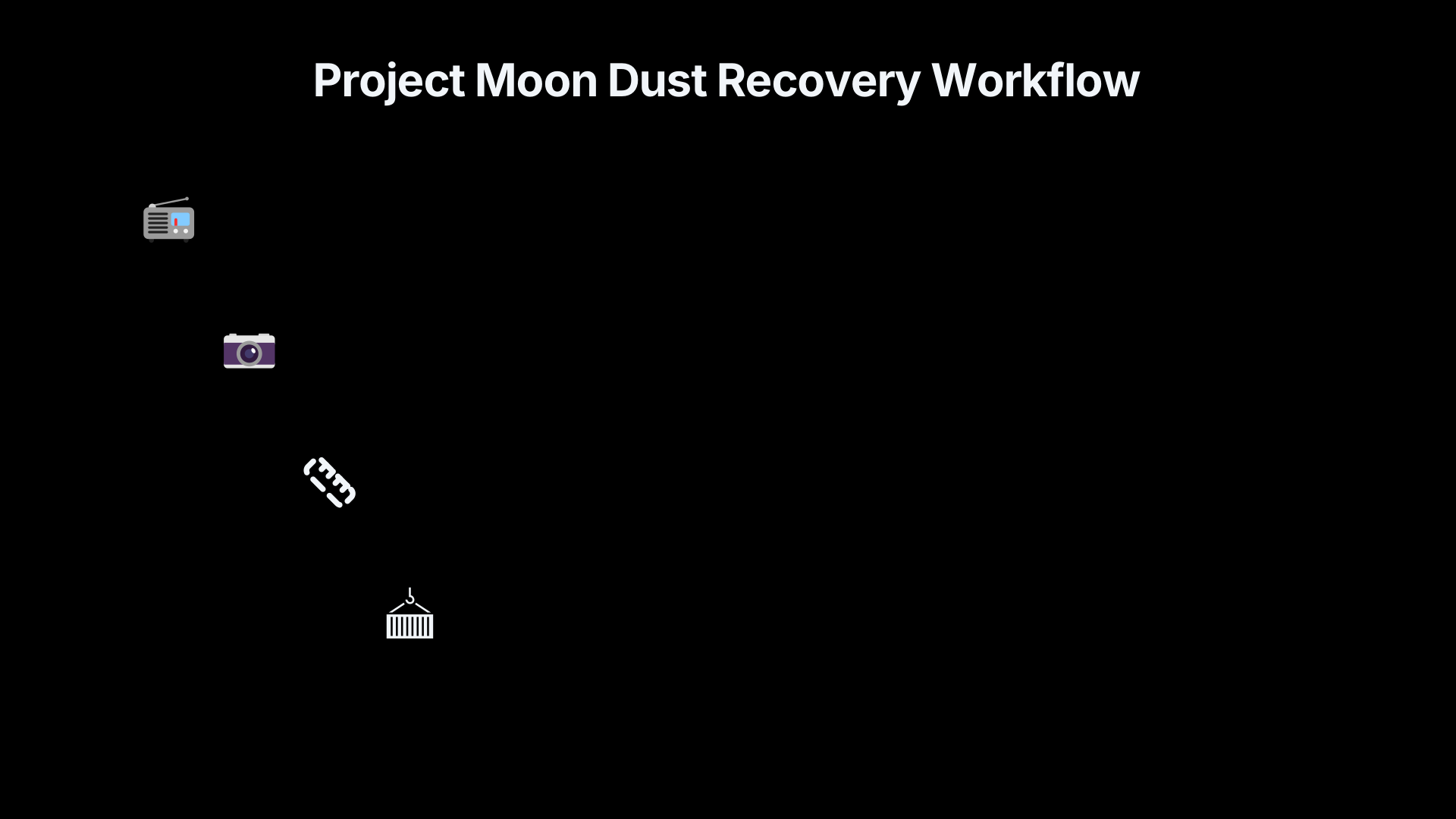
The documents show a recurring pattern. Local authorities or foreign officials reported an object. Diplomatic posts gathered information. Technical experts attempted identification. If the material appeared significant, arrangements could be made for examination, transport or return.[Government Attic]Recovery programmes were real.Open source on governmentattic.org.
This process helps explain why Cold War governments often preferred controlled handling rather than public discussion. Before the object’s origin was known, officials had incentives to minimise speculation while preserving access to potentially valuable hardware.
Real Examples of Debris Disputes
The broader historical record confirms that such disputes occurred. National Archives material describes a case in Saudi Arabia in 1967 involving a spherical object believed to be space hardware. American officials sought access to the object for analysis and eventually became involved in diplomatic efforts concerning its return. The episode illustrates how seriously governments treated recovered aerospace fragments, even when their origin had not yet been conclusively established.[The Text Message]text-message.blogs.archives.govgive us back our junk space debris 1968The Text MessageGive Us Back Our Junk: Space Debris, 1968 - The Text MessageAugust 9, 2022 — 9 Aug 2022 — When space debris identified as…
The United Nations later developed formal reporting mechanisms for discovered space objects, reflecting the fact that recoveries were sufficiently common to require international procedures.[UNOOSA]unoosa.orgList of Reported Space Objects Discovered by Member States. In compliance with article 8 of the…Read more…
What the Records Reveal About Actual Recoveries
The most important contribution of the Moon Dust documents is that they move the discussion from rumour to documented practice.
The records do not describe a secret hunt for extraterrestrial craft. Instead, they show officials dealing with identifiable problems created by the Space Race: rocket tanks, spacecraft fragments, unidentified re-entry debris and ownership disputes. Reports originated from locations including Asia and Latin America, where unexpected debris falls could place potentially valuable technology in the hands of third countries.[Government Attic]Recovery programmes were real.Open source on governmentattic.org.
Several themes recur throughout the files:
- Uncertainty was common at first contact; many objects were initially unidentified.
- Technical assessment often required photographs, measurements or physical inspection.
- Diplomatic communication could continue for months while origin was investigated.
- Recovery and examination were considered legitimate national-security activities.[Government Attic]Recovery programmes were real.Open source on governmentattic.org.
This is significant because modern discussions of Cold War debris incidents sometimes assume that rapid military interest automatically implies something extraordinary. The Moon Dust records show that military and diplomatic involvement was often a routine response to potentially identifiable aerospace hardware.[Government Attic]Recovery programmes were real.Open source on governmentattic.org.
Why the Records Matter for Kecksburg Claims
The value of Moon Dust for understanding Kecksburg lies less in direct evidence and more in historical context.
No publicly released Moon Dust document has demonstrated that the Kecksburg object was recovered under the programme. The available records mainly cover years after the December 1965 incident and do not provide a documented chain connecting Moon Dust personnel to the Pennsylvania site.[Government Attic]Recovery programmes were real.Open source on governmentattic.org.
However, the files do establish several points relevant to later claims:
-
Recovery programmes were real. Government agencies genuinely organised efforts to locate and analyse fallen aerospace objects. Government Attic
-
Foreign hardware was valuable. Soviet or otherwise unidentified objects could justify rapid official action. Wikipedia
Amazon book picks
Further Reading
Books and field guides related to What Moon Dust Reveals About Fallen Debris. Use these as the next step if you want deeper reading beyond the article.
Area 51
Offers useful background for understanding why recovered aerospace materials were treated as sensitive.
The Right Stuff
Rating: 4.5/5 from 8 Google Books ratings
Places debris recovery and aerospace competition within the broader early-space-age context.
The Cold War
Explains why foreign hardware and space technology had intelligence value.
Challenge to Apollo
Directly addresses Soviet space technology that programs like Moon Dust sought to understand.
eBay marketplace picks
Marketplace Samples
Live-tested eBay searches with available results related to this page.




Endnotes
2.
Source: aerospace.org
Title: brief history space debris
Link:https://aerospace.org/article/brief-history-space-debris
Source snippet
Aerospace CorporationA Brief History of Space Debris2 Nov 2022 — The creation of humanmade orbital debris, and the need to survey these o...
3.
Source: unoosa.org
Link:https://www.unoosa.org/oosa/en/ourwork/spacelaw/treaties/introouterspacetreaty.html
Source snippet
The Outer Space TreatyTreaty on Principles Governing the Activities of States in the Exploration and Use of Outer Space, including...
4.
Source: 2009-2017.state.gov
Title: Department Outer Space Treaty
Link:https://2009-2017.state.gov/t/isn/5181.htm
Source snippet
State DepartmentOuter Space Treaty - State.govTreaty on principles governing the activities of states in the exploration and use of outer...
5.
Source: text-message.blogs.archives.gov
Title: give us back our junk space debris 1968
Link:https://text-message.blogs.archives.gov/2022/08/09/give-us-back-our-junk-space-debris-1968/
Source snippet
The Text MessageGive Us Back Our Junk: Space Debris, 1968 - The Text MessageAugust 9, 2022 — 9 Aug 2022 — When space debris identified as...
Published: August 9, 2022
6.
Source: unoosa.org
Link:https://www.unoosa.org/oosa/en/treatyimplementation/arra-art-v/unlfd.html
Source snippet
List of Reported Space Objects Discovered by Member States. In compliance with article 8 of the...Read more...
7.
Source: Wikipedia
Title: Kecksburg UFO incident
Link:https://en.wikipedia.org/wiki/Kecksburg_UFO_incident
8.
Source: youtube.com
Title: Project Moon Dust | Episode 8 | The Secret UFO Retrieval Program
Link:https://www.youtube.com/watch?v=uKAT4yK_AyY
Source snippet
Kecksburg UFO Crash: The Untold Story | The Government Lied! | Full Documentary | UFOTV®...
10.
Source: governmentattic.org
Link:https://www.governmentattic.org/ExecBr_N-Z_docs.html
Source snippet
, 1967-1972 - [PDF 8.2 MB - 03-Jun-2024] Department...Read more...
11.
Source: governmentattic.org
Link:https://www.governmentattic.org/
Source snippet
e Freedom of Information Act.Read more...
Additional References
12.
Source: nti.org
Link:https://www.nti.org/education-center/treaties-and-regimes/treaty-principles-governing-activities-states-exploration-and-use-outer-space-including-moon-and-other-celestial-bodies-outer-space-treaty/
Source snippet
Outer Space TreatyThe Outer Space Treaty obligates Parties not to place any objects carrying nuclear weapons in orbit, on the Moon, or on...
13.
Source: un.org
Link:https://www.un.org/en/global-issues/outer-space
14.
Source: youtube.com
Link:https://www.youtube.com/watch?v=QiZxd61igSw
15.
Source: docs.house.gov
Title: HHRG 118 GO12 Wstate ShellenbergerM 20241113
Link:https://docs.house.gov/meetings/GO/GO12/20241113/117721/HHRG-118-GO12-Wstate-ShellenbergerM-20241113.pdf
Source snippet
United States Department Of Defense And The...Nov 13, 2024 — Belvoir had responsibility for recovery of foreign space vehicles under Pro...
16.
Source: conference.sdo.esoc.esa.int
Link:https://conference.sdo.esoc.esa.int/proceedings/sdc9/paper/229/SDC9-paper229.pdf
Source snippet
Satellite Fragmentations and tracking data available via. LeoLabs to...Read more...
17.
Source: satobs.org
Title: Visually Observed Natural Re entries latest draft
Link:https://www.satobs.org/reentry/Visually_Observed_Natural_Re-entries_latest_draft.pdf
Source snippet
Observed re-entries #22.xlsx"Corona Associated Space Debris", Memo, National Reconnaissance Office, 1...
9
6
18.
Source: leonarddavid.com
Title: secretive project moon dust details revealed
Link:https://www.leonarddavid.com/secretive-project-moon-dust-details-revealed/
Source snippet
Secretive Moon Dust Details Revealed3 Jun 2024 — New revelations have come to light regarding Project Moon Dust, long known by Freedom of...
19.
Source: documents2.theblackvault.com
Link:https://documents2.theblackvault.com/documents/nasa/21-HQ-F-00500.pdf
Source snippet
The Black VaultJuly 27, 2021 Office of Communications John Greenewald...Jul 27, 2021 — analysis of debris sent to NASA by any other age...
Published: July 27, 2021
20.
Source: facebook.com
Link:https://www.facebook.com/wrhstol/posts/the-united-states-has-never-officially-admitted-it-was-involved-in-project-a119-/1402274431934112/
Source snippet
The United States has never officially admitted it was...In August 1967, an object described as a satellite crashed and was recovered in...
Published: August 1967
21.
Source: open.spotify.com
Title: 1P7Eu1wf YZARXBBd Wo Ckf H
Link:https://open.spotify.com/episode/1P7Eu1wfYZARXBBdWoCkfH
Source snippet
MOON DUST: The UFO Recovery Team That Didn't...29 Oct 2025 — We examine the 1965 Kecksburg incident where MOON DUST teams recovered some...
Topic Tree